MY LIFE – Derek Machan
The earliest known picture of me.
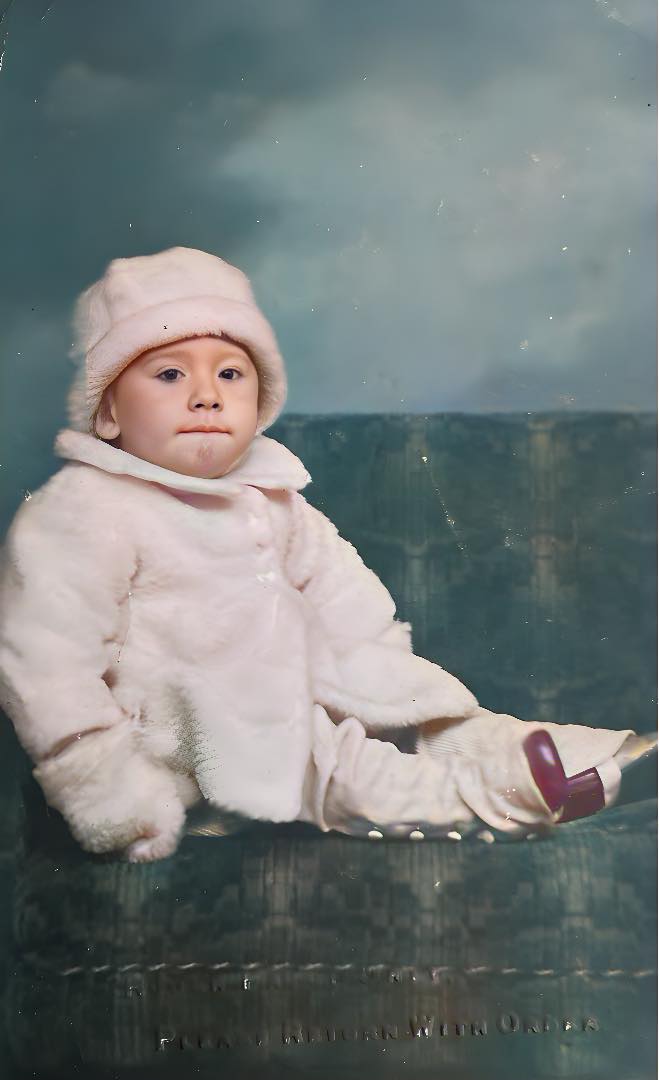
I was born on the 23rd 0f December 1935, or so I have been told. I don`t remember a thing about it.
Born at 20 Westwood Avenue, although father recorded living at 99 North Street South Bank.
At some point moved to Amber Street in Middlesbrough.
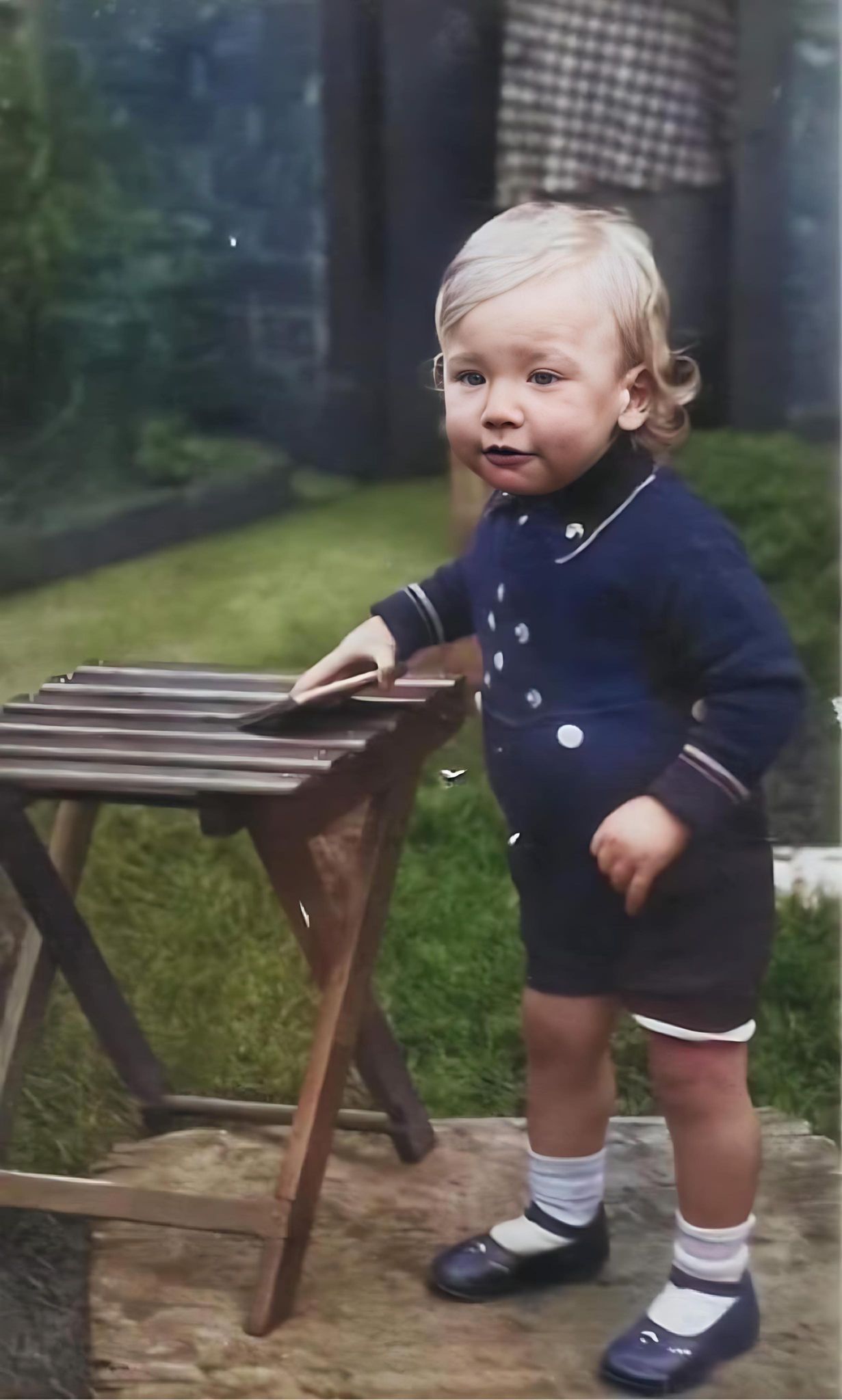
My earliest memories are attending hospital for sun-ray treatment, at hospital again to have my tonsils and adenoids removed and having milk forced down me by the Head Mistress at school, non of which are happy recollection s. All of those events are as vivid today as when they happened although I don`t know in which order they occurred, however they took place during the first 5 or 6 years of my life.
My other early memories were being woken and taken down the street to the air raid shelter in my pajamas,shoes and dressing gown during bombing raids, and taken one night to see Binns a big department store on fire.
During the war years, my father who was in reserved occupation working at the shipyard, left home each morning at 6-30 to be at work at 7-00 and when he arrived back home at 6-00pm, having to do fire watch duties during the night before returning to work the next morning.
Apart from building war ships such as Corvettes, Smiths Dock also had ships in for repairs after suffering shell and bomb damage. Then the work force had to work round the clock to get them repaired and back to sea.
With having two yards one on the Tees and a second on the Tyne, if there was more urgent work at one yard men would be sent there from the other yard. Often after working all day, then sent to the other yard to work all night.
I have always remembered that period during the war and have to smile when today I hear people talk about how hard they work !
My next recollections are between the ages of 6 to 14 and consist of playing football, cricket and cycling and during the winter months lots of sledging. We seemed to have had heavy snow falls every year that lasted for weeks. Equally summer was always sunny and warm.
Football and cricket were played in a field along side a mental rest home and later we were allowed to play in the field at the back of the home where there were goal posts.
At that time in the early 1940`s there were injured service men suffering from stress and mental breakdowns being treated at the Home and shortly after we started playing there, one or two would come out to watch us and eventually they would play with us.
Although nobody from the medical staff came out to speak to us I would like to think we helped in a small way towards the patients recuperation.
In the summer months we often cycled out to a spot called fairy dell and splash about in the stream. Often taking a sandwich and orange juice and spend the day there.
In the winter months it would be football until it got dark then hide and seek until bed time.interrupted at 7-00pm for Dick Barton special agent on the radio.
During these years we also managed to get a bit of schooling in.
The primary school was over a mile away and we walked there and back, including lunch time.
There was no school buses or school meals then.
My main recollection of that time was being told to stop singing in music lessons because my voice had started to break and I wasn`t singing sweetly.
At 11years I sat the 11+ examinations and failed. There were only two grammer schools in the whole Tees-side area and places in those schools were restricted. At that time Tees-side was expanding rapidly, the war was over and industry was changing over to peace time work and attracting people into the area. I C I a major chemical industry was opening a new plant which would employ 15000 and there were no schools being built to take the surge in school children.
If you failed to get in the grammar school you went to the secondry modern where class sizes could be over 40 pupils.
After the war Britain and America were the only manufacturing countries capable of providing the rest of the world with everything from ships, machinery, building equipment such as bricks and cement to house hold equipment such as toilets taps etc.
Agriculture could not produce all our needs so we imported meat and grain from Australia, New Zealand, Argentina and the States and exported our goods around the world.
The secondary school I attended was also over a mile away and could boast of having two international footballers, one pre war Bobby Stewart who then played for Middlesbrough and who Stanley Mathews said was the hardest full back to beat, and Ray Barnard also a full back who captained the England youth team. Ray was about 3 years above me and in the year above was a lad called Brian Clough who later played for Middlesbrough and England and went on to be one of the best football managers.
At 13 I started playing football for Marton Cricket club boys. The captain was the son of former Middlesbrough footballer Jackie Carr who picked his pals for the first team so I played in the second.
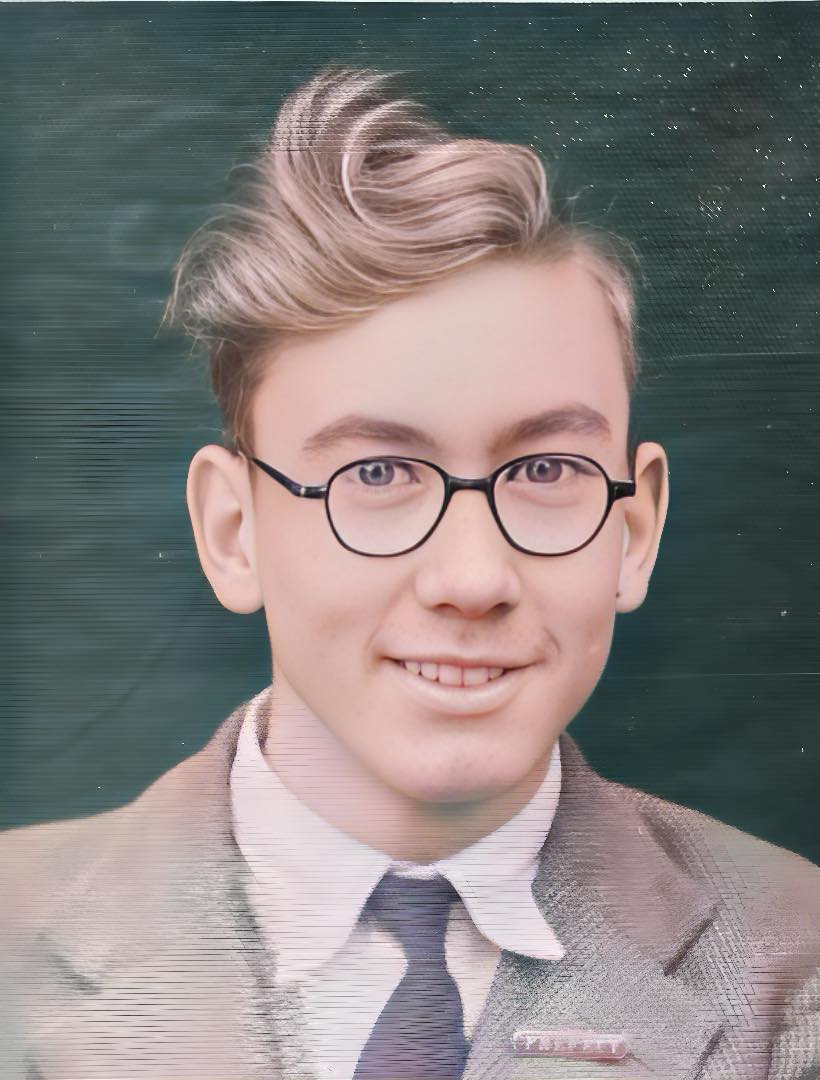
At 14 we left Middlesbrough and moved to Redcar.
The day of the move I was instructed to get an early bus to Redcar and get the house open before the furniture van arrived while my parents did a last minute clean of the old house.
I left at about 8-00am and got on the first bus not knowing it was a works bus going to ICI, where I was left on the side of the road, in the rain about 7 miles from Redcar. I had no idea when the next bus would arrive or where the bus stop was and worried that the furniture van would arrive before me. There were very few cars in those days but eventually one came along and I was able to get a lift into Redcar, arriving at the house in good time.
The move meant a change of schools.
At Middlesbrough the teachers were young and enthusiastic,mainly ex service men and I enjoyed going to school there, but at Redcar it was the exact opposite, a mix of staff long past their sell by date and the rest who couldn`t care less. They were the worst of my school days ,thank goodness it was only for 9 months.
As I was leaving school at Christmas when I reached 15, in the half term holiday my pal and I decide to go to ICI and put our names down for jobs when we left school. Our reception was very brief in that they took our names and addresses and told us they would notify us when they were recruiting.
I left school at lunch time on my 15th birthday and went to Middlesbrough with my mother to get an eye test. As we came out of the opticians I got a sever pain in my back which bent me over. We some how managed to get on a bus home and I was put straight to bed where I stayed until Christmas Day. We were due to spend Christmas with my Aunt and Uncle and he came to collect us in his car. I have no idea what the pain was or what caused it, I didn`t see a doctor and over the next couple of weeks I recovered.
At the begining of January my pal and I returned to ICI but got the same reception with no indication of when they would recruit. With us was another boy who said that Smiths Dock were recruiting and we should try there.
My father who still worked at Smiths had told me that I should not work there but I was out numbered by the other two so leaving ICI we continued to Smiths Dock.
We arrived just before lunch time and had interviews with the Welfare Manager ( a for runner to HR) and were told to go to a cafe and get a cup of tea then return after lunch when he hoped to be able to offer us positions.
This we did and on returning the first person I saw was my Father who wanted to know what on earth I was doing there. He accepted my explanation and didn`t try to stop me.
On meeting the Welfare Manager again we were told that he had found positions for us and we were to start the next Monday as office boys prior to being accepted for apprenticeships.
I was to be attached to the General Office and my job would be to deliver items such as work sheets and schedules around the yard. In the days before computers there was an awful lot of paper work generated. For this work I was paid the princely sum of 15s-11p per week. About 70pence in today's money. This work enabled me to find my way around the yard and get to know the various departments and some of the Foremen.
In the general office there were four of us and during the first week we found that the office boys in the Drawing Office were being paid 25 shillings a week so I was nominated to go to the Welfare Manager and see why we were not on the same rate. A few days later there was a result, but instead of us getting an increase the Drawing Office boys got their wage reduced to our level. They were not best pleased and I learn`t an important lessen, not to use other peoples working conditions to try and improve mine. The rest of my working life I argued my own case separately.
After 6 months we were sent to the Training School where we experienced each trade employed in the yard, spending a week working at each one. This gave us a valuable insight into the various crafts involved in building and repairing ships. On Friday afternoons we attended the lecture room and received talks by some of the yard managers on their departments. All valuable experience.
Mr Albertus was in charge of the school and from him were learnt what a bad boss could be.
At the end of our 6 month spell in the Training School we were ready to start our 5 year apprenticeship and would be sent to the various departments to start our training.
I wanted to be an electrical engineer but there were no vacancies so I was sent to the Engineering Department. Before I could start I had to sign an Indenture tying me to the company and it`s conditions and in return the company would train me in Marine Engineering.
I was also expected to attend Technical College which for the first 2 years involved 3 nights a week.
I had already started College when I commenced work so by the time I started my appretiship I was already in my second year.
The course at College had commenced in the September and I started in the following January, in March we were told that if we wanted to sit the exams we had to pay the fee the next week
The following week I turned up with my money and was told that as I had not attended from the start I would be wasting my time and money. I argued that it was my money and as I wanted to sit I should be allowed to. I won the argument and sat and passed.
Another lesson learn`t don`t accept others decisions if you consider them wrong.
An added bonus to passing the exam was to be invited to the Annual Apprenticeship Dinner thrown by the Company each November to encourage the apprentices to stick in at their studies.
Together with the Dinner we were also awarded a sum of money based on an amount for passing and additions for each mark over the pass mark. This was very welcome for buying xmas presents.
The following year I also passed so in my 3rd year my college attendance was changed to one day and one evening.
My training at work consisted in the first year the tool room ,where I operated shaping and milling machines and universal grinders.
My second and third years were spent on the lathe and bench fitting and my last two years were spent in the ship repair department. All of which were excellent training for my subsequent career at sea.
At 18 I was eligible to work overtime and I then had to work until 8-00pm 2 nights a week and Sundays. I was therefore working 8.75 hours 2 days, 11.75 hours 2 days and 8 hours on Sunday. A total of 49 hours a week. One day and night a week I attended the Technical College but during the College holidays I was working that day then my working week was 57 hours.
At that time there were far fewer Universities and only 4% of teenagers got places but most large towns had Technical Colleges where you could study Engineering,Mechanical, Chemical and Civil engineering up to Higher National levels with City and Guild courses for trade crafts.
I can`t remember there being courses for hair dressing, child minding etc.
Most of those Technical Colleges later became universities.
When we moved to Redcar I was unable to get a football team to play for and so I started cycling seriously, eventualy riding up to 300 miles a week. During the week I would ride 60 miles two nights a week and 100 miles plus on Sundays. If I had to work Sunday I would do the long days ride on Saturday. Summer holidays were two weeks spent touring England and Wales, staying in youth hostels and cycling about 100 miles each day. Over the years we toured North Wales and most of England.
With work, college and cycling I never had time to get bored.
Approaching 18, boys were all interviewed for National Service, those in training could be deferred until 21 or until their training was complete, otherwise you had to serve 2 years in the forces. You were given a choice of joining the army, navy or air force. I selected to join the air force at the interview but as I was deferred until 21 so I could complete my training, that gave me another 3 years to decide if I was going to sea. If I did decide to go to sea I would have to serve a minimum of 5 years.
As I approached my 21st birthday I decided to go to sea on the basis that if it didn`t work out I could revert to the forces.
To be eligible to join a shipping company you had to pass a medical and be interviewed by a Board of Trade Surveyor who graded you depending on your training and education.
These grades would also determine how much watch keeping time you had to have done before you could sit the exams to obtain certificates of competency, which would allow you to gain promotions to the senior ranks.
The Board of Trade, was a government department, which oversees all UK ships and Foreign ships in UK waters to ensure they meet safety standards. Both in the vessel and the officers and crew.
The departments with those responsibilities can change, dependent on the government of the day i.e. Apart from the Board of Trade it has been under the Ministry of Transport and at present the Marine and Coastguard Agency.
Having been graded and passed the medical the next step was to go to a Shipping Office and obtain a Discharge Book and Identity Card. These you keep throughout your time at sea.
Each voyage you did would be entered in your Discharge Book, recording when you signed on at the start of a voyage, and discharged at the end of the voyage, whether it was in Home Waters or Foreign and comments about your ability and conduct.
The next step was to apply to a shipping company for a position as Junior Engineer Officer.
At that time on of my pals and I were into modern jazz music so we decided to apply to companies that sailed to America. One of the companies we chose was Esso and he applied first and was accepted, however when I applied there were no more vacancies so I then applied to T&J Brocklebank who traded to India but also sailed from there to America
We both found things not as we expected, he spent all his time with Esso sailing between the UK and the Persian Gulf and I found that only 2 Ships a month sailed from India, one to the Northern States and the other to the Southern States. Not to the West Coast of America as we had hoped.
Brocklebanks gave me a position and on the 31st of December 1956 I joined the ss Maskelia in Liverpool. My sea career had commenced.
The Maskelia had just arrived home and was to discharge cargo in Liverpool, Manchester and London then proceed to Middlesbrough for voyage repairs.
Although I had worked on ships for the past few years doing repair work, I now had to learn how to operate the various machinery and equipment and this had to be done quickly. The ship carried 6 engineers a Chief, 2nd,3rd 4th, junior4th, and me the 5th engineer. The operation and maintenance of the engines and auxiliary equipment is carried out by the 3rd 4th and 5th engineers supervised by the 2nd and at sea we worked 4 hour watches and in port we were on day work. In port one engineer has to remain on board at all times. This is referred to as night a board and is taken in turn by the 3rd,4th & 5th engineers. A new 5th engineer with no previous operational experience can not be trusted so he has to learn fast, to be able to take his turn.
After a couple of weeks I was deemed capable of keeping the night aboard to look after the vessel. In port the main engine would be shut down but we would have a generator running to provide electric power, a boiler and various pumps. These would all be attended to by the Indian crew but if there was a problem you would be called on to make a decision.
We had a couple of days discharging in Liverpool then sailed up the canal to Manchester to unload cotton from the Southern States of America. At that time cotton from America bound for Manchester had to be delivered there and could not be offloaded else where then transported by road. Because of the locks and speed restriction traveling up the canal took over 12 hours. This was certainly not cost effective for may be 50 tons of cargo.
We had the Saturday in Manchester and I was taken by the other engineers up town to the Long Bar for a few drinks then to the Adelphi dance hall. A good night out!!
When we returned after midnight, the sea watches started, to get the ship ready for departure and early morning we sailed back down the canal and out to sea on passage to London.
We completed discharging at London then sailed to the Tees to have voyage repairs carried out by Smiths Dock. We spent a week at Smiths then moved to a loading berth at the town dock.
Now we were loading cargo and still doing repairs which were being carried out by my old work colleagues as well as the ships engineers.
On days when I was not night aboard engineer I was able to go home for the night which I did most nights. On the Saturday night I told my parents that I would not be home Sunday as we were doing shut down repairs. This is work that can only be done when all the engine room plant is shut down and there is no cargo being loaded, and because we worked late I stayed aboard that night.
On Monday the 21st of January I was in the engine room when I was instructed to report to the Captains office straight away. Very apprehensive, not knowing what to expect I reported and found the office full of people one of whom was the Chief Engineer. They all appeared a bit embarrassed, then the Chief said he`s one of my lads I`ll tell him. He took me into the Captains cabin and tried to speak and in the end put a piece of paper in my hand and said here you had better read this.
The paper was from Smiths Dock branch office at the loading dock and read “ We have been asked by the Main office to tell you that your Father died this morning.”
The message was written in pencil, obviously by a junior clerk, factual and without any sympathy. It took a minute to sink in then the Chief said get changed son and go home immediately to which I replied “I`m overhauling a valve and had better finish that first.”
The Chief said “no you don`t your mother will need you now, just go.”
As I walked away he “said how are you off for money lad” to which I replied OK it only costs a shilling on the train. He said “I don`t mean that, this could be an expensive time for you, if you need anything let me know.”
I arrived home about lunch time to find my mother with my aunt in the kitchen and I was told I would have to go to Grange Town to inform my Fathers Sister which took most of the afternoon, so I didn`t have time to stop and think what came next.
The rest of the week would have been very busy with funeral arrangements but at some stage I found time to go to the shipping office in Middlesbrough and sort out my tax coding as now I was the only earner in the house and I had to state how much I would be giving my mother out of my salary.
On the Tuesday morning I received a letter from the Company expressing their condolences
And at the end of the week another letter asking if I would be returning to the ship. There was no pressure put on me to go back, but they would have to find a replacement if I could not return.
My uncle advised that I could leave the Merchant Navy and claim exemption from national Service on compassionate grounds but my mother would have non of it and insisted I continue with my new career.
My Fathers funeral took place on the Friday and on the following Monday I rejoined my ship and later that week sailed for London to compete loading and hand over to the deep sea crew.
I had about a week in London before being relieved then was sent to Tilbury to join the ss Malabar which had just arrived and was discharging. From Tilbury we sailed to Newport in Wales then to Dunkirk to dry dock and have repairs carried out. The French repair firm were to work round the clock so I was detailed to work nights to be on hand to give them any spares etc they required. Sleeping on board during the day would be difficult due to the noise, so I was put up in a hotel. I would have my breakfast on board then go to the hotel and sleep until 2 or 3 pm then have a snack. The first day I asked for a tomato salad and each day after that, that was what I was served, even though I kept asking for something different.
On my last day at the hotel I had my snack then decided to go for a walk through the town.
It was a Friday and market day so the town was packed and it was difficult walking through the streets. I eventually came up against a crowed blocking my way. I squeezed past them and found the way clear so carried on walking then heard a whistle being blown and voices shouting, of course they couldn`t be shouting to me, I was a stranger and didn`t know anyone there.
The whistle got louder and so did the shouting so eventually I stopped and turned around to see what all the noise was about.
I found that I had stepped off the pavement and was crossing the road against the traffic and the whistle blower was a policeman who had pulled his gun out and was pointing it at me. I quickly retreated apologizing profoundly.
This episode started my deep distrust of the French.
After the repairs were complete we sailed to Hamburg and hit the night life down the infamous Rieper Bahn.
This was an area were a young 21 year old on his first time abroad could have been led a stay however I survived and enjoyed the experience. One of the night clubs had a young English band playing and I have often wondered if they were the Beatles who did play in Hamburg before they became famous.
After Hamburg we continued round the UK and Continental ports, loading cargo, eventually arriving back in London where I was relieved and came home.
I had been away 2 1/2 months and without any contact with home I was pleased to see my mother coping well after my Fathers death and her son leaving home and felt the decision to carry on with my career was the right one.
I had about 2 weeks at home then received my next order to join the ss Malakand in London to sail deep sea.
We left London bound for India calling at Ceylon first and normally we would have sailed through the Suez Canal but at the time the British and Egyptians were having a little war and the canal was closed so we had to sail round the Cape of Good Hope. On the way we called at Dakar to take on fuel and after rounding the Cape we sailed up the African Coast to Durban.
These were two places, I would not get the chance to visit again for many years, so the canal being closed gave me an opportunity I wouldn`t normally have had.
I can`t remember much about Dakar but do remember riding in a rickshaw pulled by a Zulu at Durban.
After Durban we sailed across the Indian Ocean to Ceylon and on arrival found we had to wait a week or two, outside the harbour for a discharge berth to come available. Once inside I got my first taste of the East.
We were in Colombo for about 3 weeks discharging and during that period we did maintenance on the machinery not in use when the engines and boilers were shut down. When not working we would explore the city and visit the Colombo Swimming Club where we could join as temporary members. This was an exclusive club for Europeans and frequented by Managers of Businesses, Embassy staff and such like. They would call in after work for a sun downer and meet up with their wives and children who had been there most of the day. We enjoyed it because as well as being able to get a cooling swim, the drinks were cheap. Drinks in the hotels and bars cost a fortune so those places were visited infrequently.
After completing discharge of the Colombo cargo we sailed to the Indian Coast calling first at Tuticorin at the southern east corner of India. We lay about 1/4 of a mile off the coast and discharged into barges and children would swim out to the ship begging for money which we threw into the sea and they dived for it. This was a great pass time for them and they got payed for it.
We were at Tuticorin for about a day then sailed up the coast to Madras, my first Indian port, and my introduction to the vast difference of the rich and poor. There were hordes of beggars everywhere and they followed you asking for money. On the pavements there lay the severely disabled of all ages and you were warned not to give money as this would bring more who would surround you and it could get dangerous. It was hard to walk by and took some time to get used to this.
Madras was a fairly modern city with wide roads and large shops and the prices were much lower than the UK so we felt quite well off when shopping. As soon as we docked tailors came aboard and you could order made to measure shirts, trousers and suits which they would make and deliver the next day, all at a fraction of UK prices. We all got our tropical shirts, shorts and boiler suits made there.
We were at Madras for two or three days then sailed for Calcutta, but on arrival off the river mouth, found a queue of 40 plus ships waiting to get in. Calcutta is about 100 miles up the river Hoogley and we anchored in the roads waiting our turn to go in, for over a month.
We lay so far out that we could not see the coast and this had to be the most boring time of my whole time at sea. Each morning we would go on deck to see which ships had gone in during the passed 24 hours. Apart from the boredom it was also very hot, this was July and just before the monsoon time, and with the ship stationary there was no breeze so the temperature was in the 40`s and the ship had no air conditioning.
Eventually it was our turn and we proceeded up river taking 15 hours before reaching the docks.
Here we completed our discharge of cargo and commenced loading a cargo for the Southern States of America. During our time in Calcutta we would often go to the cinema. These were very modern and had air conditioning so often we would go and during the film fall asleep. The best sleeps we had during that summer.
After about 3or 4 weeks there we sailed to East Pakistan now Bangladesh, here we lay in the river surrounded by jungle and loaded from barges which had come down from Dhaka and then sailed to Chittagong. At both these ports we loaded jute. From Bangladesh we returned to Colombo where we spent another week loading tea then sailed for the States.
By now the war in Egypt was over so we could go through the Suez Canal and the passage from Ceylon to the Horn of Africa was very pleasant after the Indian Coast with a fresh breeze and cooler temperatures.
At Aden we stopped to take on fuel bunkers and got my first taste of ultra cheap prices for all things ranging from cameras and electrical goods to watches and clothes. Aden was a duty free port so passenger liners would call there for fuel and the passengers spend as if money was going out of fashion. I bought an automatic watch for about £5 which lasted me for over 20 years.
From Aden we sailed up the Red sea to Suez, then the Canal to Port Said and into the Mediterranean.
At Suez we picked up a Pilot and Search light operator, ( at night each ship has a search light to light up the banks of the canal and the ship in front) and a number of Egyptian traders trying to sell all manner of cheap tatty goods and also three card fleecers. This was another eye opener for some one to experience for the first time.
The passage through the Mediterranean and crossing the Atlantic was fairly routine and I can`t remember anything of interest happening. The junior 4th and I continued overhauling the deck machinery and doing relief watch keeping and after 3 weeks leaving Port Said we arrived at Charleston Savanna.
We docked early morning and as I had done the 4 to 8 watch I had the rest of the day off. After breakfast one of the deck apprentices told me he had to take a couple of crew members to the doctors and I could have a lift into town in his taxi. I jumped at the chance to get my first experience of America.
When we arrived at the doctors we had to wait in the passage way as blacks were not allowed into the waiting room to mix with white people.
This was in the days when there was strict segregation and was another experience I would never forget.
In India and Ceylon, although there were places where blacks and whites didn`t mix it was more like private clubs in the UK and most places were mixed.
The experience at the doctors is the only recollection I have of Charleston although I did go for a walk round the town.
From Charleston we sailed to New Orleans, home of Dixie land jazz arriving at the weekend so two days off to explore. The surprising thing I remember about our arrival was how cold it was after Charleston even though we were further South.
Saturday afternoon we got the street car named Desire through the French Quarter into the city.
We soon found Bourbon Street and wandered into a few bars to hear the music but couldn`t stay in them long because of the the price of a small glass of beer, which we tried to make last but as soon as your glass was 1/2 empty the waiters were pushing you to order more. Of course with each round they expected a good tip and got nasty if the tip was less than they expected.
Sunday the junior 4th engineer said he had promised to take one of the deck apprentices to church, and as he had no idea where to find a church I tagged along thinking he would give it up and we would just go sight seeing. Shortly after getting into the city we found a church and the service was just starting. We went in and sat in the back pew and a man next to us passed me a hymn book open at the right page so we could join in.
After the service we were filing out and at the door the vicar was shaking hands and having a word with everyone. When we got to him, on finding we were English we were invited to a barb-e q at the rectory, however the man who was sat with us butted in and said he was going to take us on a tour of the city. I remember feeling very hungry and very disappointed to miss out on a free meal.
Our new friend drove a Cadilac and did give us an excellent tour, finishing up in Pat O`Brians the most famous bar in Bourbon Street. And he bought the beer.
The following day we sailed down the coast to Brownsville, a town on the Texas Mexican border then to other Gulf ports in the Gulf of Mexico including Galveston which in those days was like a town out of a western film with high wooden side walks. My best memory of
Galveston was having a memorable steak in a Mexican restaurant.
On our return to New Orleans we found the temperature was up in the 25c range and a lot more pleasant, this time it was my turn at night aboard so I didn`t get to hit the town. We completed loading here mainly cotton, and then it was time to sail for the UK.
The Atlantic crossing in late November was stormy and after 8 months of tropical and semi tropical weather we were brought back to reality, docking in London on the 6th of December.
I had completed my first Deep Sea voyage and after being away for 8 months I was glad to be going on leave and arrived home the following day at about 8-00pm to find the only welcome I got was from the dog. My mother was out with my Aunt and Uncle so I had an hour or so with Raq, my dog who was pleased to see me.
My leave was spent catching up with friends and visiting old haunts and getting to spend Christmas and New Year with the family. My mother was in good spirits and had settled into a routine living by herself.
Early January I was asked to rejoin my ship and found I was the only engineer to return, all the others had been replaced and I had been promoted to senior 4th so now had charge of a watch.
I had really enjoyed my first trip and we all got on well together but on my return I found the new Chief and Second engineers very different and it was not a pleasant atmosphere. The 3rd kept mainly to himself and the juniors although friendly, there was not the same rap-ore as the previous trip.
As the Suez Canal was now open we didn`t have to go round the Cape this time, and we now carried cargo for the Red Sea ports, Jedda, Massawa, Asab and Djibouti, apart from Jedda I managed to get ashore at the others. They were one street towns with a sleepy atmosphere, nothing moving and very quiet.
At the end of the Red Sea we called at Aden to take on fuel then sailed for Gan Island, one of the Moldive Islands. Gan is one of the most southern most Islands across the equator and at that time Britain was building an air strip there as a refueling base. There were three groups there, The Air Ministry, the RAF and Costains the civil engineers and they all had there own mess rooms. As Gan was pretty remote a visit from a ship was time for a party so most nights we would get invites to one mess or another for drinks. They also arranged football matches and snorkeling over the reef. There was a coral reef around the Island so we had to anchor outside and discharge into barges. We were carrying construction materials for the air strip and as there were only a couple of barges,discharging took some time and we must have been there for about two weeks.
From Gan we sailed up to Ceylon, then Calcutta and Bangladesh, returning to Ceylon on our way to the States. This time we were only in Colombo for two days and on the first night I found that Dave Brubeck the modern jazz pianist and his quartet were playing so I eventually got to see one of modern jazz greats.
After Ceylon we sailed up to Aden, through the Red Sea and Suez Canal and across the Atlantic to the States. My recollections of this time in America consists of visiting the same Mexican restaurant in Galveston and getting a very cold reception. We got our steak but it was obvious that gringos were not welcome.
The other event that sticks in my memory was getting on a bus in New Orleans and an incident that happened. The buses were single deck and had two doors, one at the front by the driver and one towards the back. We got on at the front and paid our fare then moved half way down the bus and sat down. The driver then shouted your in the wrong seats and as the bus only had a couple of other passengers we could not see what he was on about so we remained in our seats. He kept on at us and it transpired that the rear half of the bus was for Blacks and we should have sat in the Whites section at the front. Another demonstration of the colour bar that existed at that time.
In one of the gulf ports one of the Indian crew went sight seeing and was stopped by the police and as he had very little English he was unable to get them to understand who he was and that he was off a British ship. The result was they locked him up and we sailed without him. Our agent finally found out where he was ,got him released and had him transported to our next port.
Our last port of call was Pensacola and after loading the Captain decided to sail without waiting for a pilot. This resulted in him running the ship aground on a sand bank and damaging the rudder gland. We were unable to cross the Atlantic with the damage so had to wait for a replacement to be flown out from the UK and fitted. This together with the repair took about a fortnight which we took full advantage of, going to the beach each afternoon and visiting the local bars at night.
Eventually with repairs complete we sailed for home, again docking in London at the beginning of July. This time I had asked to leave the Malakand to gain experience on another ship but also because of the atmosphere on board which had not improved over the voyage.
When I arrived home my mother had a long list of jobs she wanted doing so I spent the next month decorating, gardening, sevicing the hoover and putting in TV aerials, for her and the neighbours.
I eventually got through the work list just as I received a letter telling me to join my next ship,
I had had a months leave and spent all of it working. My mother was very apologetic that I hadn`t had no time to enjoy myself but I was only glad to be going away again.
The next ship was the s.s. Mathura which was built in 1916 so it was 42 years old and was one of the largest ships in the fleet. I joined as senior 4th engineer to do the coastal voyage which took two months to discharge and load cargo`s and complete voyage repairs. We did a number of UK ports and Hamburg & Rotterdam finally ending up back in London where I expected to get relieved. None of the previous engineers were returning apart from the 3rd so I was told to go home and get my deep sea kit and return to sail deep sea. When I returned I found that the 3rd had to leave due to his son being seriously ill and this resulted in me getting promoted to 3rd.
As 3rd I was responsible for the main engine, the electrical generators and electrical systems and the refrigeration plant. In the more modern ships there would have been a junior 3rd as well to split the work load.
We sailed mid October calling at all the Red Sea ports and Ceylon and getting to Calcutta just before Christmas.
The celebrations on board over the festive period were great, we had no presents to open but the food was excellent and we had time to relax. Being an old ship I had, had plenty of repair and maintenance work to do on the passage out and I had been working in excess of 70 hours a week.
After New Year we had completed discharging and were about to start loading for the UK when another one of the company ships in Calcutta had a major disaster, and would be stuck in port for over a month having repairs carried out, so would miss her scheduled sailing.
Another ship due to due to sail to the Northern States of America had to take the place of the damaged vessel and we would have to do the States sailing.
Because of the age of the Mathura she had not done the Atlantic crossing for years and the old girl now showed her reluctance in having to do this.
The Mathura was one of the biggest cargo carrying ships in the fleet and we found that there was very little cargo to take from Calcutta which meant we would have to take on water ballast.
The ballast tank was aft of the engine room and as we started to fill the tank water started leaking into the engine room. It took over a week to repair the leaks and with a few hundred tons of cargo,on a ship capable of carrying 13,000 tons, we sailed from Calcutta to Visahakhapatnam where we were to load manganese ore. The ore would improve the vessels stability by giving us a deeper draft, so it was another disappointment to find on arrival that the cargo had been canceled. We were now going to have to cross the Atlantic with a light ship during winter.
Crossing the Indian Ocean and the passage up the Red Sea passed without incident but going through the Suez Canal the windless valve chest cracked leaking steam and meaning we could not use the anchors. We had to carry out a temporary repair by building a box around the chest and filling it with cement. This repair lasted for the rest of the voyage. On leaving the Canal we sailed down the Mediterranean to Algiers where we docked to have the windless surveyed by Lloyds before our Atlantic crossing.
At that time Algeria was a French Colony and there was civil unrest so the town had a 9-0pm curfew and the town was full of French Foreign Legion soldiers.
We were there a couple of days and one afternoon I was walking out of the dock to go shopping when I heard a shout which I ignored as I didn`t know anyone there. The shouting got louder and persistent so eventually I turned round to see what was going on, to find two soldiers pointing machine guns at me. I was taken into a shed and questioned, which was difficult as I didn`t speak French and they didn`t speak English. Eventually I convinced them that I was not a terrorist or mercenary and they let me go. Another reason not to trust the French.
We sailed from Algiers after the surveyor gave approval to continue with the cement box repair and headed for New York.
At the start of our passage we had very rough weather and with a light ship we rolled and pitched at a very slow speed because with the pitching our propeller kept coming out of the sea.
At that time a new Liner doing its maiden voyage to the States sank due to the weather conditions. Our crossing was further South and although it was rough not as bad as further
North. The last few days we hit dense fog and although the sea conditions had improved we were now slowed due to the visibility.
Apart from the weather conditions we also had leaking boiler tubes and the governors on two generator engines started to act up, so I spent days sorting these, trying to get them working. This was important as if I wanted to get ashore in New York the generators had to be in good working order. I succeeded just before we docked.
We had the Weekend in port during which I managed to visit the Empire State Building, the Statue of Liberty and the jazz mecca Bird Land. Times Square was a disappointment with a lot of shops having a closing down sale on. From New York we sailed down the coast to Norfolk and Newport News before returning to the Big Apple for final loading.
Our spell in the States had not been incident free, we found that water from the deep tank had leaked through the cargo refrigeration chambers into the aft fuel tanks carrying the cork insulation with it. This in turn had choked the fuel heaters and resulted in having to get shore engineers to clean out the heaters. This was only partially successful and we left New York with semi choked heaters and our two largest fuel tanks full of unusable fuel.
Shortly after leaving we hit bad weather again with gale force winds and very rough seas then about 4 days out we discovered water in the two largest forward fuel tanks. We now had over 1000 tons of fuel aboard and most of it un burnable. In fact we didn`t have enough usable fuel to get home and had to divert to the Azores to refill the usable tanks. This at least gave us a night out in Porto Delgarda another placed I would never get the chance to visit again.
The rest of the passage to London was relatively free from major incidents and on arrival did a complete discharge and then sailed for Southampton to have repairs carried out. The company had decided to sell the vessel so every one went home on leave apart from the 2nd , 4th and me who stayed behind to co-ordinate the repairs.After a week the Indian crew were discharged and flown home and two local men engaged to tend the boilers and machinery. With no crew we were put up in a top hotel, to sleep and feed, apart from the night one had to stay onboard.
The ship was eventually sold for scrap and was to be taken to Japan. The company who bought it engaged a Captain who had to put together a crew together to sail her there.
Once the deal was completed we were able to finally go on leave. I had been on the Mathura for over 8 months and was never more pleased to get home, but I suppose my mother was more pleased.
After a months leave I was sent to another ship, the Markhor, which although not as old as the Mathura was built in the 1930`s and another vessel that required a lot of care and attention.
This time we did the usual run, calling at Red Sea ports ,Ceylon and the Indian Coast to Calcutta then returning home. No Atlantic crossing this time and arriving back in London in September.
I had decided that I would go to the Marine College at South Shields to study for my 2nd Class Certificate so I remained with the ship for another month going round the coast discharging and loading, eventually leaving in late October and starting College the following week.
As the college had no student accommodation I had to find lodgings in the town during the week and going home at the weekends. Starting a course in November, I found that all the lodgings were full so I had to stay in the Seamens Misson which was rough to say the least.
The rooms were Spartan and cold and the meals were virtually inedible. My days were spent at lectures, taking copious notes and the evenings studying usually in bed trying to keep warm. No nights out at the pub so Saturday night at home was a welcome relief having a drink with my old mates and going to the dance.
Because as mature students we couldn`t afford to be away from work for long without any money coming in the courses were crammed into weeks in stead of years.
To obtain Engineering Certificates you had to pass two sets of examinations, part A then part B.
A had to be passed before sitting part B.
The part A course lasted for 12 weeks and having been away from colleges and studying for about 4 years I found it hard at first to get back into the routine, especially with it being a crammed course.
The weekends at home were a welcome relief and especially one in Mid December.
I had spent an hour having a drink wth my mates then went to the dance at the Windsor Ballroom. Towards the end of the night I met the girl who would become my wife.
In fact 1959 finished up a very good year.
I sat the part A examinations in Mid February, consisting Maths, Heat & Heat Engines,Applied Mechanics and Technical Drawing and managed to pass first time.
The following week I started the Part B course which would take 8 weeks studying Electro-technology, Naval Architecture, and two papers on Engineering Knowledge.
As well as the four written papers we would also have to pass an oral examination at the end of the course.
The examinations were conducted by the Department of Transport the Government department responsible for Marine Safety, and not by the college.
I sat the examinations the week after the Easter break during which, instead of studying I had spent the time going out enjoying my self with my new girlfriend and as a result failed.
I had now been ashore for nearly 8 months and the money had run out so I had to go back to work and joined the ss Mahanada in June followed by the Malabar, both coastal sailings then in November I resat the examinations and this time passed after a couple of weeks at college doing a quick cram.
I returned to sea straight after the exam without waiting for the result and coasted the Makrana returning home about the 10th of December.
Shortly after arriving home I received a letter informing me that I had passed and after a quick trip up to Newcastle to collect my new Certificate of Competency I phoned my shipping company to inform them that I had passed and was available to return to duty.
As it got closer to Christmas I was anticipating being at home, but a few days before I received a letter to report to the ss Mahseer at Liverpool on the 23rd of December as 2nd Engineer. I didn`t get to spend Christmas and New Year at home but I did get to celebrate my Birthday on my first day as Second Engineer.
At this time there was a shortage of engineers and to sail round the coast I had a 3rd,4th & a first trip 5th and one electrician. This on a ship that carried 7 engineers. After a week discharging in Liverpool we sailed at 10-00 pm on New Years Eve and having cleared the Mersey we celebrated New Year at sea. We sailed north round Scotland and docked at Smiths Dock for voyage repairs. We spent 2 weeks in the Tees during which engineers were taken off to go to other ships which caused me major problems trying to get the work programme completed. There was also a serious problem with the Boilers Combustion system which I also had to resolve so all in all it was quite a baptism in my first job as second. From the Tees we sailed to London where I left the Mahseer and had a few days at home before reporting to her sister ship the Matra in London.
Promotions are only permanent when you do a deep sea voyage at that rank and when I reported to the Matra it was as senior 3rd engineer, a big disappointment, which increased as we sailed round the coast as the company kept changing the 2nd engineers and they were mainly engineers who had just joined the company and relied on me to show them how to operate the ship.
On our arrival back in London I was told that I was required to sail deep sea on the Matra as senior 3rd engineer so I refused and was told to speak to the Chief Superintendent. I phoned the office in Liverpool and expressed my feelings that having done a good job on the Mahseer it was unfair to be passed over by new entrants to the company. My feelings and objection were duly noted and I eventually agreed to sail as senior 3rd on the understanding it would only be for one trip, after which I would get promoted.
We sailed at the end of January 1961 and it was a fairly uneventful voyage arriving back at London at the end of June.
Arriving back home I decided that with a promotion coming it was probably time to ask Eileen to marry me, so a few days later we went to buy a ring. Eileen obviously wanted to wear the ring and show it to her friends but I insisted we went to see her parents first. We went through to Whitby at the weekend and her father was told I had something to say. When I asked his permission to marry his daughter he burst out laughing and it was left to her mother to say I could.
For the following 50+ years I have wondered if her fathers laughter was relief that he was getting rid of his daughter.
I had about 5 weeks leave then did relief work coasting 3 vessels up to the end of the year and finally got my first deep sea voyage as second engineer joining the Malakand on the 1st of January 1962.
Before I sailed Eileen and I agreed that while I was away she would explore the housing market with a view to getting married the following year. This plan would really unravel over the coming months.
The engineers under me on the Malakand were a great bunch of lads who worked with me to get a lot of equipment that had not been touched for years, serviced. Over the voyage we were able to get an enormous amount of work done and bring the ship back up to a very high standard.
On our way out we called at all the Red Sea ports, down to Gan Island and after about 2 months arrived at Ceylon to find the harbour full and that we would have to anchor out side until a berth was available. We were allowed to go in for 6 hours to take on fresh water and once tied up the mail came aboard.
I received 3 envelopes, one of which was a large manila, which I opened first to find the deeds to a house to sign. The second letter was asking for an urgent reply to the last letter I opened ,which told me that Eileen had found a house and should she go ahead and buy it.
I had opened the letters in the wrong order and as she had already made the decision to buy the first and second were irrelevant.
The next problem was, I had been asked to send a cheque to cover the mortgage deposit and it was illegal to send money out of Ceylon, and although the money was in a bank in the UK, if the mail was opened, which was a possibility by the authorities I could be sent to prison.
As we were going out to anchor for the next week or two I didn`t have time to consider this so I wrote out a cheque and had it posted for me, then worried for the next few weeks in case the law came calling.
Eventually a berth became available and we entered Colombo harbour to start discharging.
We were there for about 3 weeks which gave me plenty of time to tackle some of the long standing defects and also routine maintenance and by the time we left Ceylon the engine room was in a far better condition that it had been for some years. Items like multi valve chests which had leaked for years and were difficult to isolate to service were now as good as new.
From Ceylon we sailed up the Indian Coast and our first port of call was Madras where I visited an Indian craft shop and saw a rug that I liked. On returning to the ship I arranged to draw enough money to buy the rug, however when I returned to the shop the following day I bought a carpet instead. Having paid for the carpet I asked for it to be delivered to the ship only to be told they didn`t do deliveries. Instead I had to get a taxi and the carpet was loaded onto the roof and off we went back to the docks. On arrival we found the ship had moved berth and we would have to cross railway lines and walk about 1/4 of a mile.
Without being asked the driver lifted the carpet off the taxi roof, onto his head, and virtually ran to the ship. I had got my carpet on board but would have similar problems when we arrived back in London.
From Madras we sailed up the Indian coast to Calcutta where we completed discharging and commenced loading for the passage home. From Calcutta we sailed to Pakistan calling at Chalna & Chittagong where we loaded jute for Dundee then proceeded back to Ceylon where we completed loading taking aboard tea, at that time the most valuable cargo from that region.
At Colombo I wrote to Eileen and said now we had a house why didn`t we get married when I returned, giving her an arrival date of mid May.
The passage home was uneventful, but we lost time, calling at the Red Sea ports and eventually docked in London on the 23rd of May. This was 10 days before we were to be married. Leaving the ship I again had problems with the carpet. At first the taxi refused to take it ,but after a bit of persuasion and the fact that it was an hours run to Kings Cross station and he didn`t want to loose the fare he agreed. When we arrived at the station all the porters ran off when the carpet was taken off the taxi so I was left finding a trolley and getting the thing on board the train. It was an overnight journey and I arrived at Redcar at 6-00 am where the station master wanted to know what I was going to do with the carpet. I replied that I would leave it in the waiting room until I could get my mate Steve to pick it up that evening. This didn`t go down well with Station Master who refused to take responsibility for it but said after the next train had gone through he would put in a wheel barrow and deliver it to the house. The first bit of luck I`d had since Madras.
Leaving the carpet in his capable hands I walked home and knocked on the door of my new house to be greeted by my wife to be. She was very relieved that I had made it in time and the wedding didn`t have to be postponed. As Eileen had to leave at 8-00am for work we didn`t have much time to bring me up to date on what was happening but I was given strict instructions to go to the solicitors at 9 o`clock and pay his invoice which she had had for a couple of months but had no money to pay it.
Over the few days before the wedding I had to decorate the kitchen, which was in a dreadful state, order a new suit and arrange a honeymoon. This was made even more difficult by my mates coming round and dragging me off to the pub. I finished up painting the kitchen at night, the mornings trying to find a hotel in London and giving the Tailor 7 days to produce a made to measure suit, which would normally take 3 weeks. We also had to go to Whitby for a meeting with the Vicar which Eileen had arranged for the Friday evening. I was give strict instructions to get a certain bus which Eileen would catch a few stops further down. I left Redcar in time to make the Whitby bus leaving Middlesbrough bus station, but fell asleep on the way and woke up past the station, and had to run back only to find the Whitby bus had left.
I then got a taxi to the school hoping that I could still catch her but she had already left and caught the bus I should have been on. The taxi took me back to the bus station and I caught the next bus and was very relieved when Eileen got on a few stops down the road. She had boarded the first bus but got off at the next stop when she realised that I wasn`t onboard. I`m still trying to live that event down!!.
When we arrived in London we were told that the ship was having a quick turn round and I would only get 3weeks leave so this meant just a weeks honeymoon and as the weather up to then had been poor we decided London would be the place.
After weeks of poor weather Saturday the 2nd of June was warm and sunny and the wedding went off as planned, everyone seemed to enjoy the event and at the end of the day we returned to our home then the next morning got the train down to London.
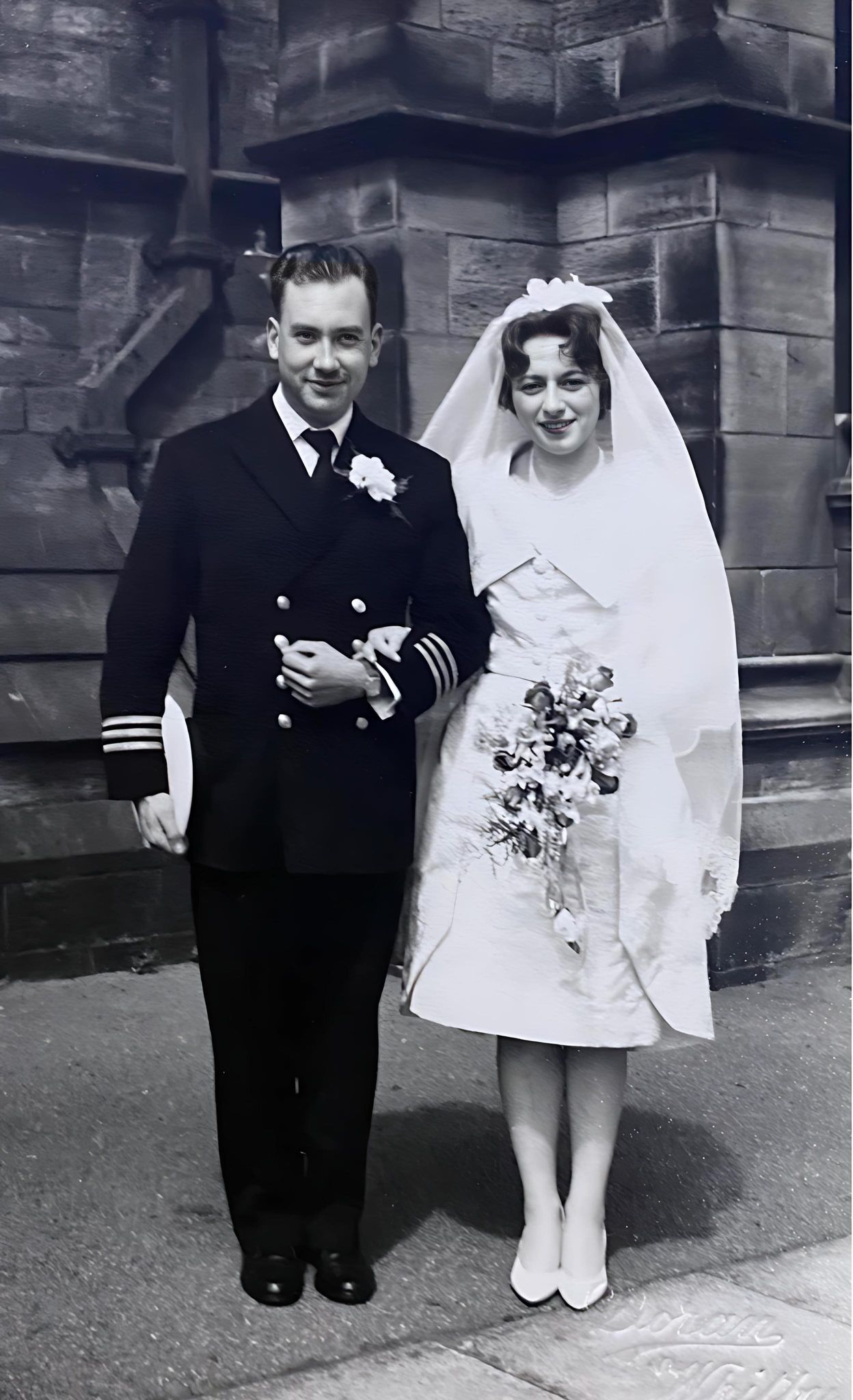
On our arrival we booked into the hotel then set off to spend the night in the west end. We had just come out on the street when another couple came out of the hotel next door and Eileen said I know that girl and it turned out to be a school friend from Whitby and her husband who had been unable to come to the wedding because they would be on holiday. We spent the evening with them then met up the following day to visit Kew Gardens.
We spent a hectic week sightseeing through the day and going to the theatre at night, managing to see the latest shows. At the end of the week we returned home to find a letter informing me that the sailing schedule had been re-arranged and I would have an extra 3 weeks leave.
This gave us time to get used to married life and living in our new house.
Eventually all good things must come to an end and it was time for me to re-join my ship.
We had planned on Eileen coming with me but as it would be September by the time we got to India and the middle of the monsoon time we agreed that she should wait until the following trip. I had a few days in London before we sailed so Eileen was able to come with me and spend a couple of days onboard.
We departed London on the 15th of July doing our usual run of Red Sea ports Gan Island and the Indian coast and as we arrived at Madras the weather got very humid with heavy rain storms.
During the coastal passage, prior to our sailing, the main cooling water pump had been opened up for examination and the casing found to be badly corroded, and the impellor slack on the shaft. The pump could not be repaired so we were told that a replacement had been ordered and would be fitted on our return. We sailed with this defective pump and managed to get down to the Red Sea before it broke down, With the temperature in the engineroom over 60 degrees we had to stop the ship and carryout a temporary repair. On our arrival at Ceylon we wanted to engage the local engineering firm to carryout a more substantial repair but were told by the company to wait until we got to Calcutta, where the company had a superintendent engineer.
On arrival at Calcutta the superintendent took over the repair using a Chinese engineering company. The pump shaft and impellor were taken ashore and the impellor re-fitted to the shaft.
This repair lasted 12 hours after leaving Calcutta and it was back to the ships staff to effect another temporary repair until we got back to Ceylon where we then engaged the local engineering company to do the repair we had wanted in the first place.
None of the engineers I`d, had the previous trip had returned and their replacements were not of the same calibre and on our passage home two had to be logged for refusing to work. This was a black mark entered in their discharge book which could stop them getting a position on another ship.
We arrived home, docking in London on the 23rd of November and that was one trip I was glad to see the back of and I looked forward to spending Christmas at home.
We would be sailing again early January and this time Eileen would be coming with me, so I had to inform the Company and Eileen had to apply to the American Embassy for a visa in case we went to the States.
Other than that it was a normal build up to Christmas, with Christmas day spent going for drinks in the morning at Steves and Christmas dinner in our own house.
On New Years day we invited friends round for drinks in the evening and we were all having a good time when one of the Ladies who lived next door came and asked Eileen if she would come and see if her niece was alright, as she had been in the bath along time. Eileen went over and came back a few minutes later for me, saying she thought the niece was dead. That put an end to the party and the next few hours were spent getting hold of a doctor, the police and the nieces relatives. I had to assist the police in lifting the body out of the bath which was not a good experience. The relatives arrived in the early hours of the morning and took the aunt back to their home and we could finally get to bed. What a New Year!!
A few days later I received the letter telling me to report back to the Malakand for the next voyage.
As we would be away for 5 or 6 months we put all the dinning room furniture in one corner and covered it up with dust sheets. We also arranged with a plumber to come and turn off the water and drain the system after we left, to avoid frost damage. More about this later.
The chief engineer called a couple of days before we left and said he would be driving down to London over night and could pick us up instead of getting the train down.
When we arrived back on board I found the engine room filthy and various systems defective, it was so bad that the superintendent apologised and gave my relief a verbal lashing. The first couple of days were spent sorting out the defects and general cleaning. The passage down the Channel was fairly calm but once we entered the Bay of Biscay the weather changed and we hit very strong gales. I came off watch at 8-0am and found Eileen still in bed saying she wouldn`t bother with breakfast and asked if it was very rough. I said no it would get far worse and she should get showered and go for breakfast. This she did and on entering the saloon got a round of applause led by the Captain. After breakfast the ship was hove to, to ride out the storm. The best part was Eileen was never bothered by the weather or sea sickness during the voyage.
As we sailed south the weather improved and the passage through the Mediterranean was calm with the temperature rising each day. At Port Said, Eileen got her first taste of the Middle East when the Arab traders came aboard trying to sell their wares together with the 3 card sharks.
After the passage through the Suez Canal we turned into the Gulf of Aqabah and docked at our first port. The Captain had arranged with the agent to provide Eileen and I with a guide and transport to see the town and surrounding area and one sight I remember was seeing the remains of the film set for Laurence of Arabia. That night we were invited to the harbour masters house for Dinner, a real middle eastern meal. He had also invited some of the local dignitaries so it was a perfect night out for Eileen.
From Aqabah we sailed down the Red Sea calling at Massawa, Jedda, Assab and Djibouti and at each port apart from Jedda, Eileen was able to go ashore even if it was just a walk through the town. We then crossed to Aden to take onboard fuel then carried on through the Gulf of Aden to Mukalla which was reputed to be the port the Queen of Sheba sailed from to visit King David.
Here again the Captain had arranged a guide to take us round. We were taken to see the summer palace of the Calif then on returning back to the town we saw a Camel Train ready to leave. On our return to the port Eileen was presented with a bunch of flowers and a bottle of perfume.
Leaving Mukalla we had a few days at sea, before arriving at the Seychelles. This was a time before the Seychelles became a tourist spot, there was no airstrip and you could only get there by sea. Once a month a ship sailing from Mombasa to the far east called for a few hours with mail and once a year a ship from the U.K. with general goods. This time it was us and with the population this was a big event, a good excuse for a party. As there was no discharging jetty we anchored in the bay and went ashore on the freight barges. That evening as we stepped ashore
we were surrounded by half the town and escorted to the famous Sharkeys Bar where we had a very good evening. In the bar we met a game warden from East Africa who had married a Seychellese girl and was here on leave. He offered to meet us the next morning and take us round the Island. The following day we met up and he drove us to his sister in laws house for lunch then we had a tour of the island ending up on the beach for a swim. During out tour we saw the giant tortoise and the town center where, I was accosted by the local girl about town, even though I had my wife along side me.
At that time the Americans were building a satellite tracking station and while we were on the beach one of them came by and passed the time of day. Later he returned and said he had booked a table at the near by hotel for dinner.
Our host and guide had brought his niece, a girl about 16 along for company for Eileen, and it transpired that this American, who was in his 30s had been trying to get involved with the girl, and of course the family disapproved.
However since the table had already been booked and Eileen and the girl were already in the hotel we had to join them. The meal was eaten in a very tense atmosphere, We all ordered from the menu except the American who in a very loud voice told the waiter he would have an omlette, which they could probably make without touching the ingredients, as they had not heard of hygiene here. This was in the top hotel on the island. The uncle turned to me and told me of a safari he had run for a party of Americans who on walking through the bush came across a pile of elephant dung. One of the party exclaimed what on earth is that, and on being told what it was, said box it up to take home, they aint seen anything like that where I come from. A very good put down.
We left the Seychelles the following day and steamed south east across the equator to Gan Island. As on previous visits the Air Ministry, RAF and Costains vied for our company inviting us for drinks at their respective messes.The RAF also arranged a football match with us on a sandy patch, and as they were super fit and we hadn`t played for years we came of the pitch aching and bruised.The RAF Provost invited Eileen to go swimming and as some of the other lads warned me that the Provost was a womaniser I went along as well, much to the dismay of our host. We spent a fantastic afternoon swimming in the lagoon and across the coral reef, fascinated with all the fish, large,small and all the colours of the rainbow. Outside the reef the sea bed fell away to one of the deepest anchorages in the Indian Ocean with an abundance of sharks. As we were anchored outside the reef and discharging into barges we were there over a week before making our way back across the equator and up to Ceylon.
This time instead of docking in Colombo we sailed up the east coast to Trincomalee, a deep water harbour surrounded by jungle. Again we would be discharging into barges and this would have been a boring period for Eileen if a friend who worked at the ship repair company in Colombo hadn`t decided to take leave and come up to see us. While I was working Cecil took Eileen off in his car to see Ceylon.
They spent a day visiting Habarana & Polonnaruwa the Islands capital in the 11th century and the next day they went round Trincomalee and saw the jewellery market and then they went on to Fort Fredrick, a fortress built in the 17th century which had a little of it`s original splendor remaining, walls and a gateway. Then they went to Mount Swami where they had just built a
new Hindu temple, built on a rock which is supposed to have been cast down by the wind with two other rocks from the Himalayers. The drive to these places were over very poor roads through jungle and they saw plenty of wild life such as monkeys, snakes and elephants.
Later going to the Sea Anglers Club to a party for drinks and a meal of lobster salad etc.
The following day I went with them to Sigiriya, the lion rock which rises six hundred feet above the plain and was named by King Devanampiya in 266 BC. In 41 BC King Mahalauti built a rampart and meditation house there and in 19 BC his son erected a large alms house there for priests. Then in 477 A D King Kassapa used it as a palace and fortress. Over the centuries Sigiriya lay buried in the forest until it was discovered 1831. One of the outstanding attractions were a series of beautifully preserved frescoes discovered within the pockets of the rock. To get up the rock there were steps up to a gallery, along which were frescoes, but to reach the top you had to scramble up at the end of the gallery over very slippery rocks without hand rails or any other safety features. Looking down there were two smaller rocks which from a distance would appear as giant elephants guarding the fortress.
The time spent in Trinco was probably one of the highlights of the trip for Eileen and we have often talked about it.
Leaving Ceylon we sailed up to the Indian Coast with our first port of call being Madras where I changed a large amount of money to use both there and in Calcutta. Eileen went ashore with the Captain who showed her around the city, visiting parks, the sea front and the church where Clive of India was married and the city center.
From Madras headed up the coast to the entrance to the Hooghly, then a 12 hour passage up the river to Calcutta where we arrived early Sunday evening. We hadn`t bothered with dinner on the ship as it was our intention to go ashore for a meal. However when the customs came aboard they impounded all our Indian currency saying it was illegal to import Indian Rupees into India. The fact that we had drawn the money in Madras didn`t seem to count and arguing that Madras was in India was ignored.
The only one with any money was the Purser so I conned him into taking us out for a meal, however instead of going to one of the smart restaurants he took us to Nisams a typical Indian eating house where we sat on benches in cubicles with swing doors, similar to the cowboy saloons, and ate chicken curry and chippaties with our fingers. One, if not the best curry I have ever had.
The following afternoon Eileen told me that an Indian was with the Chief Engineer and had seen a painting she had done of the Chiefs daughter from a photograph and was insisting that she did one of his son. I told her to refuse because if she didn`t get the boys complection the right shade it could cause offense.The Indian turned out to be Daddy Masda who owned half of Calcutta.
Not wanting to offend him she only agreed on the condition that if, by the end of the week when we would be leaving, she hadn`t finished it he couldn`t have it. He agreed to this and he and his friend, an Australian who had the slot machine franchise for Bengal, invited us all out for dinner. Leaving the ship in their Rolls and Bently we were taken first to Daddys bachelor flat for a drink.
The flat had various artifacts with tiger skins on the floor and was a den of seduction. Eileen
was taken with a brass coffee pot and Daddy said she should have it in payment for the portrait, we tried to refuse but he wouldn`t have it.
From the flat we were taken for dinner to Firpo`s one of the top hotels in the world which Daddy part owned. During the rest of the week Eileen was taken ashore on shopping trips and one evening we were invited to visit Brocklebanks new ship the Makor by the Chief Superintendent.
We were due to sail on the evening of our last day and I had told Eileen to make sure the painting was still wet so Daddy couldn`t take it, but when he arrived he said it was perfect, rolled it up and took it as a present for his wife`s birthday.
We sailed on the evening tide back down the Hooghly and up to East Pakistan, now Bangladesh, sailing up the river towards Dhaka. We had to anchor in the river a few miles from Dhaka and loaded jute for Dundee from barges. Either side of the river was thick jungle, so we had no where to go, however one afternoon a few of us decided to take the lifeboat for a run and went up one of the creeks where we found a small village. Going ashore we found the place deserted then a couple of men appeared and once they realised that we were not there to cause harm a few more appeared. Still there were no women. Eileen was wearing shorts and had short hair so she had been taken for a man then once they realised that she was a woman, the village women appeared with their children. They were very friendly and sent a young boy up a palm tree to get coconuts for us to drink the juice.
From Dhaka we went to Chittagong, this time docking alongside. Going ashore we found a fair but the stalls had very little of interest, selling table cloths and clothes.In the center there was a space ship but nobody gave it a second glance. The one stall that had a large group around was advertising contraceptives and demonstrating how they should be used.
Prior to Calcutta the 3rd engineer had been overhauling one of the electrical generators and on the passage between Dhaka and Chittagong this engine suffered a major failure which put it out of action for the rest of the voyage, leaving us with only two generators.
We left Chittagong having loaded more jute and sailed down the bay of Bengal to Visakhapatnam where the radio equipment had to be surveyed. A LLoyds surveyor came aboard to carry out the survey and on finding my wife was onboard invited us ashore that night for a meal. He and his wife picked us up that evening and told us they had to call in to farewell party given by the local Maharajah for an English couple returning to England and we should go along with them. We arrived at a villa and found that the party was being held at the roof top garden and as we went up there was a power cut and the only light was from torches around the garden. We had been told to say no ice in our drinks when we ordered but Eileen forgot when she ordered her gin and tonic. The drinks were served and the surveyors wife told Eileen to send hers back and say she wanted one without ice. Not wanting to offend Eileen decided to fish out the ice and throw it on the garden and just as she threw it the lights came back on and everyone saw her do it. They laughed and the incident passed without anyone being offended.
The next day we left and made passage to Ceylon, this time docking in Colombo.
The first night we went ashore to a chinese restaurant where we dinned on baked crab starter then crab claws in ginger sauce with rice and vegetables. A meal once eaten never forgotten.
One day we went shopping and I took Eileen to a jewelers I had bought from before, and bought her a scorpion broach and opal ring and my mother a moonstone ring. The scorpion cost about £7-00 and if any stones have to be replaced they cost about £50-00 each in the UK.
The Chief Engineer suggested I should take a day off and take Eileen to Kandy so one early morning we got the train and arrived at Kandy about 11-00am. I got a taxi and told the driver that we wanted to see as much as we could before getting the train back to Colombo. He was very good and we started off visiting the temple of the tooth, which is supposed to house one of Lord Buddha`s teeth which is paraded around the city on religious days. No body can see the tooth apart from the highest monks. There is a very large reclining Buddha and you have to remove your shoes to go in. The temple was very crowded and after walking round it was a relief to leave. From the temple we were taken to the Botanical Gardens where there was a large orchid display. We wandered around the gardens, had some lunch then were taken to see the
Elephants being bathed and one of the Mahouts asked if the memsahib wanted to ride an elephant which I thought would be an experience so said yes. A thin cloth was placed on the elephants back and Eileen had to straddle the beast. She was hanging on for grim death when the Mahout got the elephant to rear up with its front feet up a tree. Thankfully it came down quickly and Eileen was able to dismount. That made my day and over the years Eileen has recounted how I made her climb a tree on an Elephant. It had been a full day at Kandy and after the elephants we returned to the station to catch the train back to Colombo.
Most days in Colombo Eileen was picked up by one of the wives of my shoreside friends who took her sightseeing, usually finishing up at the swimming club being wined and dined.
We were about 10 days in Colombo loading then left for home, calling at Aden for fuel and then the Red Sea passage, the Canal and through the Med up to the UK docking in Tilbury on the 29th of May. The night we docked Eileen phoned her brother Don who was working near Tilbury and he drove down to the ship and we had a night out together.
The following day I got relieved and we returned home, arriving to find my mother waiting for us crying her eyes out.
Although we had arranged for the water to be turned off, and the system drained after we left, an amount of water had remained in the cold water pipe under the bath and this had frozen during the winter breaking the pipe. My mother had,then had the water turned back on prior to our arrival and water had flowed out of the broken pipe through the ceiling flooding the dinning room. Not a perfect home coming.
The next morning was spent notifying our insurers and arranging for the carpet to be uplifted and taken away for drying. I had decided to leave the Malakand and return to college to study for my 1st class certificate but when I enrolled I found that they were not running the course again until September so I had to phone the company and ask to do relief work for the next 3 months. Unfortunately there wasn`t a ship available for me until July so I had 6 weeks at home decorating.
In September I returned to college and sat the part A exams in December and January then with money running out returned to work in February, coasting the Mangla then going deep sea on
the Matra, in March, returning at the end of August. Before we sailed Eileen found she was pregnant and during the passage out Eileen had pneumonia and I only learn`t of this when we arrived at Colombo. We had not received up to date mail at Aden or Gan so I was didn`t know that she had been taken to Whitby and my letters were sent to Redcar.
In the days before the internet and wide spread use of phones, mail was the only means of communication and this could take weeks to some countries. From Colombo we went up to Madras then got an unusual order to go to Bombay to load sugar, instead of Calcutta.
On arrival at Bombay we had to anchor outside to wait for a berth and for some unexplained reason the Captain would not let anyone go ashore or any mail to come aboard. I had, had a run in with the Captain earlier on in the voyage and with my concern about Eileen this was the final straw and resulted in me having a row with him.
After loading cargo we headed home with the air electric between him and I and it was a relief when we finally docked in Liverpool on the 24th of August, where a letter was waiting for me to inform me that by the time I read it, I would be a father,
I sent a telegrame to Eileens mother telling her that I would phone the call box outside their house at 7-00pm and would she be there to get my call. When I phoned it was Eileen that answered the phone, saying it had not happened yet but she was going into hospital the next day and by the time I got home it would be all over.
Leaving the ship two days later I traveled home to Redcar and the following day through to Whiby. When I got to the house there was nobody in so thinking they would be at the hospital I went back into town to buy some flowers, however when I returned, there was Eileen in the kitchen cutting bread, and no baby.
All through September we were expecting an imminent arrival but this baby was to comfortable and refused to enter the outside world. Towards the end of the month I phoned the company and told them as my wife still hadn`t given birth and I would not be returning to the ship. This was not what they wanted to hear and I had the chief superintendent telling me that I would be better off returning as I would only be in the way during the birth. Although he tried hard enough to get me to sail I still refused and told him I was staying home until I was sure everything was alright with my wife and the baby. During September I was traveling back and forwards between Redcar and Whitby, at Redcar decorating the baby`s bedroom and getting the outside of the house painted, a job Eileen had organised early in the year.
Eventually the Doctors decided they had waited too long and decided that Eileen should have a cesarean and Janet entered the world on the 30th of September, screaming blue murder. In fact she was so noisy she had to be separated from the other babies and was put in the laundry.
After Eileen was discharged we stayed in Whitby for about a week then returned home to Redcar. I remained at home until near the end of October then notified Brocklebanks that I was available and was sent to join the Mahanada on the Tees where she had been under going a major survey. Once the work was completed we commenced loading in Middlesbrough then sailed to the Antwerp before ending up in London where I left the ship on the 23rd of November.
I had a few days at home then joined the Maturata in Birkenhead to sail deep sea.
On joining the ship I found Gordon Alison, the ship repair firm, were working on the main circulating pump and discovered that the pump shaft was bent. I instructed them to take it
ashore and get it straightened. The next day the shaft was returned but I found it was still bent.
Over the next 3 days the shaft was continually sent ashore to be corrected, but still found to be bent on it`s return. Alisons management were convinced that I was crazy as they kept saying it was straight when checked in the workshop. It got to Saturday after noon and I had said I wanted the shaft spun between centers in the lathe and I would come and inspect it myself.
At lunch time the Chief Engineer asked me if I had any last minute shopping to do as we were sailing the following day and said he would go to inspect the shaft.
I returned from my shopping trip and was told that they hadn`t spun the shaft but had turned it on vee blocks and it was straight. Two hours later it was back on board and still bent.
Back it went to the workshop and this time I went as well and it was spun in the lathe as I had requested and it appeared straight. The management, our superintendent and the chief went to one side for a discussion and I was feeling a right fool. However I asked the machinist to slacken off the centers then re-tighten them and spin it again. This time the shaft didn`t spin true showing it was clearly bent and I had great delight in calling the others over to witness it.
The next morning I got a phone call from the superintendent saying they had tried most of the night to correct the shaft but eventually realised it was plastic and we would have to sail with it and a new shaft would be ordered for our return.
Later that day we left Birkenhead with the dodgy pump, however we did manage to complete the voyage without any problems with it.
Over the past few years the price of fuel oil had gone up and the company had ordered that all ships should steam at a reduced speed to conserve fuel. If we had followed this instruction we would have spent Christmas day at sea but our Captain ordered full engine revolutions and we managed to get to Aden in the early hours of the 25th. After filling our fuel tanks we moved to a berth where we could shut down the engines and have Christmas Dinner all together. Leaving Aden we sailed straight to Calcutta seeing in the New Year at sea and docking early January.
We had a full cargo to discharge in Calcutta and then loaded tea for the passage home so we were docked there for about 3 weeks then sailing to Colombo to pick up more tea. Tea was one of the most valuable cargo`s to carry and ships had to make good speed on the way home to get best prices in the market. A full cargo of tea could pay all the ships expences and provide a hansom profit. We docked in Liverpool on the 27th of March and Eileen came over to Liverpool to spend the weekend with me as I was not getting relieved until the Monday.
Monday morning my relief arrived early but it turned out to be chaotic, as well as trying to hand over to him we had a Board of Trade Surveyor onboard to carryout a safety survey, the customs and having to sign off. Eventually we managed to get away and arrived home late that night and I got to see my daughter again. Janet was now 6 months old, very alert and energetic and fun to play with. She was my daughter so when we went out I didn`t let anyone else push the pram. In the house she demanded that I built towers with her bricks but she was so impatient to knock it over I don`t think it ever got more than about 10 inches high.
In April I returned to College to complete the part B of my 1st class certificate so each weekend I was home, and when I returned to work in July it was a bit of a drag. I coasted the Mahseer then sailed deep sea on her, leaving London about the 15th of August and returning mid December.
During the trip I decided it was time I gave up the life at sea and on return would look for a shore job. The company tried to persuade me to stay on and I eventually agreed to do relief work until I got a position ashore. I joined the Mahanada in Liverpool in February and shortly after received a letter from the Professional and Executive department, with details of a position with Smiths Dock. I contacted them and explained I was on a ship at Liverpool and could not attend for an interview at the present time but the ship was due to go to Smiths Dock in about a months time for voyage repairs and I could contact them then. I was told that the position could have been filled by then but I could try. In March we docked in the Tees and I went to see the Senior Engineering Manager, who told me that the position was still available and after an interview offered me the job.
I completed the coastal passage on the Mahanada and left the ship and my seagoing career at London in April 1963.
I started the next phase of my career a week later at the shipyard where I would be looking after the installation and commissioning of machinery on new vessels being built.
I had expected the position would have been on repair work and during my previous training at the yard had never worked on new buildings.
The ship I was given to look after was a fully automated diesel vessel, the Manchester Port which was totally different to the ships I had sailed on, and after about 3 weeks, feeling out of my depth I considered resigning. I didn`t because shortly after, I realised that no one else knew any more than me. The next 6 months turned out to be the steepest learning curve I had ever experienced and by Christmas I had completed my first ship and was now doing her sister ship, the Manchester Progress.
Shortly after joining Smiths Dock everyone received a letter informing us that the company would be going out of shipbuilding and doing alternate work. At that time there were 3 of us doing the work, each one a different ship, but between July and December the other two had resigned, leaving me to complete the remaining ships on order. The sister ship to the Manchester Port, and two Polish bulk carriers. As we would not be building any more ships after those, it was decided not to replace the other two engineering managers. This meant I was working very long hours for 3 weeks prior to the launch and 6 weeks up to completion and every Sunday morning, as well as the normal week. Having been used to working up to 80 hours a week at sea this didn`t bother me to much for the first year, but after 2 years it began to be a bit too much.
In July Eileen announced that she was pregnant and the baby was due in February. The Manchester Port was completed in October and I sailed with her round to Manchester, spending a week there completing a few outstanding items. Prior to leaving the Tees a big Press event took place, to advertise the ships new service between Manchester and Montreal, then on arrival in Manchester we had Tomorrows World T V people down, filming for a programme to be shown later that week on BBC1. As with the Press Event a big thing was made of the automation and in particular the Data Logger that controlled the machinery. In fact there was no data logger as the company producing it had gone into liquidation just a month prior to the ships completion and we had to quickly install an alarm system as a temporary measure until we could get a company to devise and manufacture a data logger.
On my return from Manchester I got a weeks holiday then settled into getting the sister ship the Manchester Progress finished.
Building the first ship in a series provides many head aches, getting equipment installed correctly and systems to work as called for by the specification. You also find Owners keep wanting to change things, which you have to try and accommodate without causing a delay in the completion date. Having sorted out all the installation and commissioning problems on the first ship the second and any subsequent ships in a series are a lot easier.
We started commissioning the Progress at the beginning of February and I was really busy when Eileen went into hospital to give birth to our son Craig. By the end of the month the ship was ready for sea trials then I again sailed with her to Manchester to help the ships engineers get used to the plant.
Returning home I was at last able to spend more time with the family.
Shortly after starting work at Smiths Dock I started taking driving lessons and in the September took the driving test. I had just left the driving center and the examiner told me to pull into the side of the road and stop. As I pulled into the road side we ran over something and on moving off again it quickly became apparent that we had a puncture. That put an end to my first test. The second test was on the morning Craig was born, and this time obviously my concentration was not good and resulted in a failure. I did pass on my 3rd attempt and we got our first car, a Ford Anglia a week later. This made life a lot easier, my travel time to and from work was much reduced and as a family we could get around without having to rely on buses and trains. Each weekend if the weather was fine we drove onto the Yorkshire Moors and had picnics, often meeting up with friends, exploring, walking and playing games.
During my second year at the shipyard we built two Bulk Carriers for Polish Owners which should have been the last ships to be built. However the company had been unable to find alternate work, then Manchester Liners asked if we would build them three Container Ships for a new service they were starting to Canada. If We didn`t build them they would go to the Far East as they were not prepared to use another UK shipyard. This would be a very large order as apart from the ships we also had to supply through a third party, all the containers. The company couldn`t turn down this order which would provide work for over a 18 months. The building would commence in the spring of the following year, 1968 after the design and drawing offices completed their work. Between the completion of the second Bulk Carrier and the start of the first Container Ship there would be a six month gap in work for the yard staff.
To fill this gap we secured an order to build two solvent tankers for Norwegian Owners.
This meant that we kept the work force employed and also saved the yard from closure.
We launched the first tanker in late November and to avoid a large penalty clause had to complete the outfitting and sea trials and hand her over by the end of the year.
This was a mammoth task as a ship this size would normally take two months to complete after launch. The effort put in by everyone resulted in us taking the ship out on sea trials on the 23rd of December and after taking two days off over Christmas we were ready to hand over on the 28th of December and she would sail the following day.
At 8-00 am on the 29th I went down to the yard to see the ship sail and was told by the superintendent that there was a problem with the refrigeration plant. I checked it out and eventually got the temperature to drop. We then waited a couple of hours to see if it was working but after dropping a couple of degrees it didn`t go any lower. We managed to get an engineer from the company who supplied the plant and he made a few adjustments but without success. The following day, the 30th we were still baffled then the refrigeration engineer decided to open the refrigeration chambers and found them jam packed with provisions. Far more than they were designed for and it turned out that the crew had not only loaded stores for their use but were also carrying stores for it`s sister ship to be transferred when she reached the Caribbean.
As this was therefore not a defect, the ship could be handed over and sail before midnight, avoiding a penalty payment. She eventually sailed at 23- 30 hours.
When I got home I found Eileen nursing Janet who had enteritis and instead of celebrating the
New Year it was off to bed.
The second solvent carrier was completed in the spring of 1968 by which time the design work and drawing of the Manchester Liners were advanced enough to start building. These vessels were even more advanced than the previous Manchester ships and marrying equipment from different manufacturers, with controls by another company proved a mammoth task.
The main engines were French Design, built by a Manchester Company, driving through a gear box built by Camel Laird of Liverpool, then a controllable propeller system of Swedish design built by Stone Manganese of London. The main engines also drove electrical alternators from the free ends. This arrangement was controlled by a system designed by Westinghouse.
Although the electrical power would come from the main engine driven alternators at sea, there were two auxiliary diesel driven alternators for port use. These together with all the vessels other systems, ie pumping, heating and safety etc, and an elaborate data logger and alarms certainly caused some headaches. The equipment suppliers were only interested in their supply so it was up to the yard to marry everything together and get it working.We eventually had the ship ready for sea trials, when most of the machinery and controls would be tested for the first time.
I was still the only installation engineer, even though we were now continuing building ships and the engineering plant would be run by me with my senior manager. Normally a sea trial would last a maximum of 24 hours but with this ship we expected to be at sea about 2 days.
Right from the start we hit problems with the control systems not working as they should and having to carry out modifications as we went along. As we put more equipment to work the problems continued. On top of this the weather turned against us with near gale force wind and a rough sea state. We carried on and eventually got everything working, with botched up controls and a long list of defects to correct when we returned. We had been out 4 days during which I can`t remember getting any sleep. My senior manager was carried off with swollen legs and I went home for a long sleep.
The next day I was back organising the modifications and getting the defects attended too ready for the ship to sail 6 days later.
Normally we would have taken at least 2 weeks to complete the amount of work required but the ship had to be on the loading berth at Manchester by a set date for a press conference and TV coverage.
The ship sailed and I drove over to Manchester to meet her and complete the final items on the defect list.
After this the MD instructed us to get more engineers and we engaged an ex Manchester Liners engineer as my assistant. I never again had to run a sea trial single handed and with my assistant was able to split out of hours work between us.
Having experienced all the problems with the first ship, the second went more smoothly and although we still had problems we managed to resolve these quickly. The sea trial was carried out in good weather conditions and although it was a long one, 3 days, we were tired but not shattered when we came off.
The second and third ships were completed in 1969 and that year with Craig now 2 years old we were able to go away on holiday. We decided to hire a caravan in Cornwall for a week then
drive into Devon where we had booked a cottage for a week.
About 3 months before this my mother suffered a series of strokes and was hospitalised for a couple of weeks then stayed with us when discharged, for about a month before returning home.
We had intended taking mother with us on holiday but after the stroke were doubtful, however after she got clearance from the doctor we all set off, leaving home at 7-0pm on the Friday night thinking that when it got dark both children would fall asleep. When we got onto the M6 the lights from the cars going north, together with excitement of going on holiday kept them awake until the early hours of Saturday Morning. We made excellent time and drove through a deserted Bristol early morning and were looking forward to getting to the caravan by lunch time. Oh how wrong we were, about 10 miles past Bristol we hit bumper to bumper traffic and spent more time stopped than moving. We put up with this for at least two hours then I decided to try an alternate route. This proved to be a good move as the roads were clear and we eventually arrived late afternoon.
I had driven down in an old pair of gardening trousers so on arrival went for a shower then looked for my clean trousers only to find we had not packed them.The weekend was spent scruffy until I could buy new trousers on Monday morning.
The week in Cornwall was great, seeing the sights and excellent weather and at the end we were reluctant to leave. However our cottage in Devon also proved to be better than expected and we had another great week.
In the summer of 1968 the first Polish vessel reported problems and the Hull manager and I together with two contractors flew to Italy to sort out the defects. The ship was berthed at La Spetzia a port down the coast from Genoa. When we arrived the Poles were more interested in partying than work, but we did manage to get the problems sorted.
A few months later the ship came out of guarantee and we had to fly over to Poland to agree the items we would accept as defects and pay for them to be corrected. At this time Poland was a communist country in the Russian bloc and the hull manager Tom was very nervous about going there.He had fears that some how we would get locked up by the secrete police and finish up in Siberia. The trip out didn`t start well. We travelled down to London and spent the night in the company flat and the next morning our agent picked us up and took us to a Polish Shipping Co, where we would change some sterling into Polish currency which we had to have before we could get visa`s. From the shippng company we then went to the Polish embassy to obtain the visa`s. On arrival they took our passports and told us to return in 2 days although our flights were booked for that afternoon. No amount of arguing had any effect so we left, found a phone box and contacted the agent. We told him what had happened and that he should sort it out and as it would to late to make the afternoon flight to re book it for the following day. Then we took his secretary out for lunch.
The following day we flew out to Warsaw expecting to be met by a Polish representative but there was no one there. After a few hours we got a flight to Gdansk where the ship was
supposed to be berthed and still there was no one to meet us. We got a lift into town on a truck then hired a taxi to tour the docks to find the ship. After about two hours we had toured all round the dock not finding the vessel and arrived at a guard hut where a very large lady guard, who spoke English told us that the ship was at Gdynia a port about 25 miles away but we could get a train there. We arrived at Gdynia and again got a taxi to tour the docks until we finally found the ship.
However between the road and the ship were railway lines and an armed guard patrolling.
Tom by this time was convinced that we would end up in prison and when I said I was not going to try talking to the guard but would crawl between the railway trucks and go aboard the ship as I had had enough messing about, he just about had a fit. He reasoned that we would need a pass to get aboard,which I agreed with, but as it was about 9-0pm and there was no one around to provide a pass I was not going to spend all night standing around.
I did crawl between the trucks, and he reluctantly followed and we finally got on board without a bullet in our backs.
We had a guarantee engineer on board and when we met him he told me they were not expecting us for another 3 days. I asked him to find the duty officer to contact their agent and find us some accommodation.
When the agent arrived he asked for our passes and when told that we didn`t have one he then had a fit.
We were taken ashore through an office block and over a wall to get back on the road where the agent had a car. He then drove us to the seamans mission, explaining that all the hotels in the area were fully booked for a literary conference, and as they were not expecting us until the following week, had not booked us rooms at a hotel.
That night, we were only to glad to get a bed after the past two days and we didn`t pay to much attention to the accommodation. The following morning was very different, I had spent nights at youth hostels which were more palatial than our rooms. At breakfast we found we had to buy slices of bread and pats of butter and any preserve we wanted to make up a meal.
About 9-0am the agent complete with passes, arrived and drove us down to the ship where the chief engineer, and a party of superintendents were waiting. We spent the morning going through the defect list and by lunch time had agreed on the items were would be responsible for, which didn`t amount to a great deal. After a very good lunch ( the first proper meal for 2 days )we were finished and asked them to book our flights home. However we were told that we had to remain to meet the senior superintendent, who would arrive the following day.
That night we went out for a meal and ordered steak which turned out to be rancid.
The next morning, Saturday we went back to the ship and sat around until lunch time waiting ,only to be told that the man would not arrive until Monday and we couldn`t leave because there were no flights over the weekend.
One of the other superintendents, when we asked what we could do on Sunday offered to take us out for breakfast. Sunday morning we got up and waited for our man to come. He turned up at 11-0am and said we were going to his house at Gdansk. We went to the station and he spent so long fumbling in his purse getting the fare that we said we would pay. Half way to Gdansk
we got off the train at Soport where we walked around the pier and he tried to buy a bottle of vodka, but obviously the price was to high.
We eventually arrived at Gdansk and at his house, which was quite an imposing building but badly in need of a few coats of paint. Inside the furniture was also of good quality but in need of a bit of care and attention.
By this time it was about 5-0pm and we still hadn`t eaten all day.
We were served a small glass of neat gin, out of a duty free bottle, he had obviously purchased on a trip aboard. He appologised that he hadn`t got any vodka but there was non in the shops.
Eventually his wife served a meal of roast chicken and although Tom and I were still hungry we both refused second helpings, thinking we were eating food they could ill afford to share.
They were a nice family and we both felt very sorry for the way they were living.
Monday morning we returned to the ship and the first person we met was the senior man who was not interested in the work only if we had any shirts or trousers we wanted to sell.
We sat around all day while they were supposed to be arranging our flights, then late afternoon they told us all the flights were fully booked. This was the last straw so we said we would travel to Warsaw on the train and would he take us to the station. We caught the overnight train and arrived at Warsaw about 8-0am and after getting some breakfast found a travel agent and booked flights home the following morning. The next problem was getting a room for the night.
The travel agent was sited in a large hotel so we tried to book rooms there but were told all bookings had to be made at another hotel and they put us on a waiting list and said we were to come back in the afternoon.
We walked around the city, site seeing and tired out returned to the booking hotel to be told they had still not found us rooms but were still trying.
I said to Tom that they needed a bit of encouragement so I pulled up a couple of easy chairs and stretched out, closed my eyes and pretended to sleep. Shortly after we were told they had found a room for us at the first hotel. When we went back there we found we had the pent house suite.
After an excellent nights sleep and a very good breakfast we went to the airport and checked in.
We got through customs and passport control and boarded the bus to cross the tarmac to the plane. The bus door was opened and two officials checked our passports and boarding cards before letting us off. The first two passengers were checked and let off then it was my turn. I handed my passport to one and boarding card to the other and there was much shaking of the heads and a torrent of polish, which I couldn`t understand except that they were not letting me off. The other passengers were asking what the hold was and I decided if I couldn`t board the plane no one else was. There was an impasse until a British Airways official arrived to see what the hold up was. He checked my boarding card and said it was the wrong card.I was very embarrassed to find the correct card was still in my pocket and the card I had handed in was an old one from a flight to Holland I had made a few weeks before. Once on the plane I realised that the bus incident had been the last straw for Tom who was convinced we would never get home again. I told him he should stop reading James Bond books.
After the three Manchester Liner container ships we built 3 more Solvent Tankers for Norwegian Owners then 2 Bulk Ore carriers, again for Norwegian Owners.
These vessels had very big cranes that ran on rails, either side of the hatches and were manufactured in Norway. Rather than dismantling the cranes and transporting to the yard it was decided to take the vessels over to Norway after sea trials and lift the cranes onboard there.
Sailing over to Norway we used the ships staff to man the vessel with me,the hull manager and 3 technicians on board. The passage over was trouble free and we tied up about 6-0pm when the crane company came aboard. They were to work round the clock and said they would have the cranes installed and working in 3 days. The first day went fine but on the morning of the second day the men left the ship and there were no replacements. It turned out that all the labour had worked 24 hours and then left to get some rest and there was no one to replace them. We were not told this and spent 24 hours waiting for them to return. Needless to say the work was not completed in 3 days and as the crane company had wagered a bottle of champagne on the 3 days we got the wine on the 5th day before flying home.
After the bulk carriers we built the 4th Manchester Liners container ship then two cargo vessels for Finland SS Co Ltd. These vessels were part refrigerated, which was a new venture for us.
There were very few shipbuilders with experience in building refrigerated ships and this led to one of the biggest orders the yard had ever had.
An Israeli company “ Island Fruit Reefers Ltd “ were building a fleet of ships to carry fruit all over the world. A Norwegian yard who we had long standing connections with, were already building a number of ships for that company and with a full order book could not take on any more ships in the time frame Island Fruit had and put Smiths Dock forward as possible builders.
There was a contract to build 8 fully refrigerated vessels which we bid for. At that time Island Fruit were having 60+ vessels built at various yards through out the world.
We secured the order and to ensure we completed the ships on time and within the price a number of Managers went over to Norway to see the ships being built at Dramen Shipyard.
We wanted to see if that yards building practices were any way different to ours and apart from some minor items we came away confident that we could do as well as the Norwegians.
The contract had price reductions on each ship ie the second vessel was 10% cheaper than the first and subsequent vessels had 5%, 3% and 2% reduction on the previous ship.
Often the builders would lose money on the first ship in a series and recoup it on subsequent vessels. With this series, because of our home work before we started building, we even managed to make a profit on the first vessel. In fact the first ship was ready for commissioning as we competed the second cargo vessel for Finland. This was a very hectic period because we were building the ships so quickly we often had one ship ready for sea trials, a second commencing commissioning and a third ready for launch. The 8 ships were completed in 3 years and we gained the reputation of being a top refrigerated ship builder.
These ships were built like cruisers with a top speed in excess of 20+ knots ( most cargo vessels had a service speed of 12 to 15 knots ) and being built for Israeli owners there were rumors going round that after they were handed over they would be converted to war ships. This was not true but all through the series the rumors persisted. We even got a number of bomb scares, usually a phone call after the work force had gone home saying that a bomb had been planted and timed to go off the following morning.
This resulted in me going to the yard at 6-0am and meeting the police to carry out a search before the work force arrived at 7-30. The were all hoaxes and of cause we never found any thing. Actually to carry out a full search would have taken a few days with people experienced in ships, not a few local bobbies.
We did however, have one experience that at the time we thought was terrorist related.
It was just after lunch time when there was a sudden loud explosion. I heard it in the office about 1/4 mile from the ship and I immediately rushed down to the ship expecting to see carnage.
It turned out that a workman had forgotten to turn off an acetylene gas bottle when he left for lunch and this had filled the enclosed space with gas. On his return he lit his burning equipment and this in turn ignited the gas. The steel side of the tank had blown off but luckily the man was un hurt apart from temporary deafness.
One of the features on the Reefers was a stern bearing ( last bearing the propeller shaft ran through ) which was designed by the Manchester Liners Superintendent, and had been fitted on the last series of the container ships. These bearings were designed to allow an examination of the bearing without drydocking the ship and instead of the usual radial seals, to stop sea water entering, had a compression seal. To achieve the right compression we had to ensure the seal was compressed 3/4 of an inch.
We were about half way through the series when we started getting reports that the bearings were getting sudden oil losses. The first ship had loaded fruit in Israel and sailed for America stopping first at St. Pier Island just off Newfoundland where she struck floating ice. We eventually got the ship into dry dock in New York and my assistant and representatives of the bearing and seal companies attended. The seal was stripped down and no damage was found so it was assumed that the pack ice had somehow caused it.
Shortly after this incident we got reports that two other vessels had had the same experience, a sudden oil loss then on filling the system up again every thing was normal.
I couldn`t accept this as just an unexplained event and sat down to analyse both incidents.
One ship had been sailing across the Gulf of Mexico and the other from New York to Europe.
In both cases the common denominator was the gulf stream where the sea temperature is a lot higher than the surrounding sea. It can be 20 degrees higher and I believed this could have a bearing on the incidents.
I contacted our design office and asked them to calculate the thermal expansion of the hull when sailing through waters with a 10 & 20 degree change in temperature. The answer was a lot greater than the 3/4 of an inch compression on the seal i.e When the hull shrank the seal lost its compression.
I called a meeting with the MD of the bearing company and a senior representative of the seal manufactures to discuss the events. I first asked both representatives for an explanation of why we were getting these failures and neither could give a logical reason, then I gave my
explanation. The seal representative accepted my reasons but the bearing MD didn`t and said that during the building we had altered the compression.
To this I said that the next ship would be drydocking the following week prior to sea trials and we would check the seal at that time and they would both have people in attendance.
The following week the seal was checked and found to be correct and I had proved my point.
This resulted in the compression on the seals being increased and to do this Lloyds Register had to approve a design change in the seal seating being changed from cast iron to cast steel.
As we were nearing the last of the reefer series I got a bit restless and asked if I could have a changed. Smiths Dock over the past 10 years had taken on the mechanical maintenance at two petrol chemical industries and they required a new manager at Shell Refinery so I finished up taking on that role. Although most of the equipment was similar to ships the terminology was very different and took a bit of getting used to.
I spent nearly 2 years at the Refinery then Smiths Dock were told that they had to take over the Haverton Hill yard by Swan Hunter, as we were part of the Swan Hunter group and I was asked to go there as Senior Manager.
I jumped at this chance to get promotion and move back into shipbuilding which I had missed at the refinery.
I soon found that life at Haverton Hill was not the same as Smiths Dock. At Smiths I had had an excellent working relationship with the work force and supervisors and at Haverton things were vastly different.
This yard had been run down and liquidated when Swan Hunter took it on, the work force had received redundancy payments and the next day engaged by Swans and when we took over they had expected the same. The fact that the yard was transferred within the group meant they were never redundant but they couldn`t accept that. Also over the years the best workmen had left and I found that the foremen were either waiting to retire or work shy. They had all suffered years of not knowing what the future held. Swans had used the yard as an overflow yard. Placing single orders there when the Tyne yards were full.
The ship being built at the time was a bulk carrier for Russia and was way behind meeting the delivery date. We were to complete the vessel for Swans and my first job was to build up the workforce. The launch date was about 3 weeks off and on my first day the engineering manager told me they had never completed the work needed to get the ship in a launch condition in the time available. I sat him down and we went through each job in turn, with me asking him to put a time on each job. At the end I showed him that the work could be completed in time, in fact with a couple of days to spare. At end we hit an unexpected problem and we did miss the date.
The ship was launched at the next high tide a couple of weeks later.
Along side the problems completing the ship, British Shipbuilders was also going through the process of being Nationalised. The organisers were meeting the yard owners and trade union leaders but ignoring the managers so we had to form an association to get our views heard.
This was the most stressful period I had experienced and I found that I was working very long hours, continuous meetings with shop stewards, and no help from the engineering foremen who
were to busy moaning about not receiving redundancy money and being expected to actually do some work.
I was also due some holiday from the previous year and at Easter we went to Switzerland for 2 weeks with friends. This turned out to be a bit of an experience. To start with the Ferry had engine problems and instead of arriving in Rotterdam early morning it was 2-0pm before we docked then we drove through Holland, Germany to Switzerland in torrential rain at near 100 mph. The first week we had a cottage up in the mountains and each night it snowed heavily so each morning we went out to find the cars covered in snow, and as there were a number of them we often started to clear off the snow then found it was not our cars. Through the days we drove around viewing mountains and lakes and generally enjoying the country. Craig had developed a chest complaint when we first arrived and this stopped us going for long walks. Half way through the week we managed to go up a mountain where we all practiced skiing and then after a picnic lunch I slipped and broke two bones in my right hand. The following day a doctor set my hand and plastered it up. The second week we stayed with our friends relations and we visited Basil zoo and Zurich, among other places.
At the end of the holiday we set off driving back to Rotterdam to catch the ferry and after about 2 hours driving I found the fuel gauge going down quickly and for the rest of the journey had to keep stopping to get petrol. We were pushed for time so I could not stop at a garage to get the problem solved and we arrived at the terminal just in time to board. When I got home I found that I had burnt out a spark plug so had been driving on 3 cylinders. In fact I had spare spark plugs with me but with my hand in plaster could not change them myself.
On going into work on the Monday morning I found that very little progress had been made on the ship and from then on it was a daily battle getting work done. Eventually the ship was ready for sea trials and Swan Hunter had a team to take her on trials after which she was dry-docked in Hamberg then to the Tyne. I never saw her again.
While we were building the bulk carrier Swans were building the hull of our next ship which was towed down to the Tees to be outfitted. This was a heavy lift vessel which we completed in January 1978 and was the last ship I was in charge of. Shortly after that I applied for a job with British Brown Boveri a major international company who had supplied electrical generators, switch boards and data loggers on all the Reefer vessels and who I had a lot of respect for.
I attended an interview in Manchester and was told that they had opened an office and workshop in Aberdeen and were involved in off-shore work, mainly commissioning oil platforms. Later they would be designing and installing modifications on the platforms.
I was offered a position as commissioning engineer with rapid promotion as the company grew.
The salary would be more than I was on at the time and a company car would be provided.
That night at home we discussed the offer and having to move to Aberdeen if I accepted and
eventually agreed I should accept.
In May 1978 I started the next phase of my carrier and soon found that things were not as I had been led to believe. The office and work shop were small and they only had 2 engineers doing commissioning work for Shell and 2 service engineers engaged in servicing Brown Boveri turbo-chargers on trawlers. I was then told that the main expansion would take place he following year when we would move into a new purpose built office and workshop at the other side of Aberdeen.
In August we moved up to a house we bought in Inverurie and in September I went off-shore commissioning on Shell Brent Bravo, an oil platform. This only lasted a few months then I was replaced by a Shell employee.
When Brown Boveri first considered opening a branch in Aberdeen they engaged a marketing company to explore the possibilities. The man given the job by the marketing company wrote a glowing report and recommended that the person in charge should be some one with marketing experience, ie he wrote him self into the position.
I never saw him bring any work into the company and supplying man power to shell was the only income apart from the turbo charger servicing.
I explored various possibilities but they were not taken up and other Aberdeen engineering firms later did provide some of the services I had recommended.
After 2 years the he was sacked and a new man was put in charge who turned out to be as ineffective as his predecessor and a year later the company decided that he should also go along with a reduction in staff, one of whom was me, I was made redundant on the 23rd of December.
My first reaction was thank God I`m out of it.
However in January when I started applying for positions I found that Brown Boveri were not the only company reducing staff. I was actually offered positions but they never materialised.
One being the local shipyard. I knew one of the managers there and phoned him to see if there were any positions and was told he would get back to me. About 1/2 an hour later he phoned and asked if I could come straight down and meet the senior engineering manager.
The meeting was short and I was offered a position subject to the OK from the MD. A few hours later he phoned to tell me that the MD had approved and he could increase the salary however all new or replacement positions had to be advertised through British Shipbuilders and filled by existing people in the industry before outsiders.
That was the last I heard from them.
A similar situation happened a few months later. I saw an advert from Sunderland Shipbuilders for a commissioning engineer manager and I phoned them to inquire if I could apply and was offered the job over the phone. I asked if the position had been advertised through British Shipbuilders and was told they were not having them dictating who they employed. However I didn`t get a letter confirming the appointment so British Shipbuilders obviously did call the tune.
I also found that when I attended interviews I was often told I was over qualified for the position and therefore they couldn`t be sure I would stay with them.
In September I attended a meeting at the Professional and Executive department in Aberdeen and they offered me a place on a management course at Bell street College starting the next Monday. Having nothing better to do I signed up.
When I arrived I found about 30 people like my self, all made redundant, from Shipyards, Engineering Co, the Forces and various other occupations.
The course was interesting but there was no jobs at the end of it.
I carried on sending C.V.s to all and sundry, most times not getting a reply, then in May 1983 I applied to an advert for a superintendent engineer with a fishing company.
Two days after sending in my CV I phoned the firm and asked if they had received my CV and where they interested. When they said they were, I told them I had another interview in two days time but would prefer their position so would it be possible to see me that day or the next.
This worked because I was asked to come in that afternoon and after the meeting I finally had a job although at a salary 50% below my previous salary with Brown Boveri.
The following week I started the next and final phase of my career.
Caley Fisheries were the largest fishing company with offices in Peterhead, Aberdeen, Fraserborough and a number of small offices along the Moray Firth and the west coast.
At that time there were about 50 ships sailing out of Peterhead, 75 out of Fraserborough and about 15 average out of the other ports.
There were two superintendents, one who looked after the Fraserborough fleet and me who looked after the rest. For general repairs the ships arranged this work themselves and my involvement was when there were problems. On top of that I also handled insurance claims and at that time there would be about 3 or 4 a week. The ships were insured for everything even negligence and their premiums were quite high, so they would claim for every thing.
The claims would start with the skipper reporting a problem to me and filling in a claims form describing the problem, the cause and events leading up to the incident, generally with me filling in the form. Often they would say something like the engine is broken down and when asked what happened they usually couldn`t say. Then I would have to go through the events leading up to the incident and starting with the failure, work back to the likely cause.
A surveyor engaged by the insurers would be notified and a repair firm appointed. Most claims were due to engine and or hydraulic systems and cost thousands. Over a year the claims could amount to over £1,000,000. Very often the repair cost would exceed the cost of renewal so we would often be installing new engines.
The most interesting part of the work was when we were building new ships. Then it was approving specifications, overseeing the building and attending sea trials. At times skippers would ask for things that would not be accepted by the surveyors, ie The Sea Fish Industry for smaller vessels or Lloyds for the larger ships as well as the Marine Safety Executive, then I would have to try and pacify them and see if we could find a compromise.
I generally had good relations with the insurance companies and their surveyors so I never lost an insurance claim and generally got good settlements which pleased most skippers but there was always the odd one who thought they should have got more.
Each morning driving into work I would wonder what new problem I would have to deal with that day. The work was varied and interesting and I stayed there until retirement.
About 1990 the Marine Safety Executive decided to up date the engineers certification and towards this engineering courses would be rearranged to meet the new requirements. This of course included the fishing industry and the Sea Fish Industry would draft a course for fishing vessel engineers and to this end required a working party to assist and oversee. I together with 4 others were seconded and we spent about 2 years working on this project, attending monthly meetings.
We had nearly completed the project when the Sea Fish ran out of money and couldn`t pay our expences. We didn`t get paid for our time.
About a year later I was asked to attend a meeting in London at the Marine Safety offices to approve the course. Also at the meeting were representatives from NVQ and SVQ who had to approved the courses. These two numskulls had no idea what a ships engineer actually did and asked the most stupid questions and made equally stupid statements. The meeting ended without any conclusion. About 6 months later the Sea Fish Industry appointed another man to take over the project and we were now faced with having to correct his syllabus.
Shortly after this we started building the last ship, I would be involved in. We drew up a specification and drawings using a design company at Macduff and a contract drawn up by McKinnons a firm of solicitors in Aberdeen. This ship would be larger than any other white fish vessel in the fleet and cost nearly 3 times the cost of the previous ship we had built. To achieve the best possible price we needed some one to take part in the order by buying a second vessel. This was soon achieved and a contract signed with Ailsa Troon shipyard.
The other party took the first ship to be built and we were to have the second with ours commenced in August 1997, and scheduled for completion the following August. Unfortunately the yard tool on another order which they slotted in before ours. This caused a delay in our building and instead of completion 4 months before my retirement the vessel would not finish until a month after.
I retired on the 23rd of December 1998 but agreed to act as consultant on the new vessel until completion. We had booked a 6 week holiday in South Africa, leaving in mid February when the ship would be completed and in service.
Over Christmas the yard shut down and the ship was left to be watched over by a night watch man. On Boxing day a Hurricane struck the west coast of Scotland and the strong winds broke the ships moorings and drove the vessel out of the harbour and on to the beach where she finished up on her side. Sea water entered the hold and engine room completely flooding the spaces and covering all the machinery. As I had gone away for Christmas I was unaware of this until the 29th of December. The ship was recovered by a salvage company who pumped the ship dry and refloated her then towed her to a berth in the Clyde.
On the first week in January a meeting was held at the yard to agree what needed to be done to get the water damage corrected and the vessel completed. The yard wanted to get away with cleaning the machinery but I insisted that machinery that had been flooded was replaced which infact involved the main engine and all the rest of the engine room equipment including the electric switchboard and all the cabling. The fish hold would have to be stripped of the linings and insulation and all flooded spaces washed down with fresh water and dried out.
The cost of this work would probably be in excess of 3/4 of the original vessel cost. And would be met by the yards insurers.
During January and February the shipyard were doing the strip out so we were able to go on holiday as there was nothing for me to get involved in.
When we returned in April the ship had been cleaned and was ready to have the new equipment installed and I was able to get involved again.
The work progressed well and in June was ready for commissioning and after a satisfactory sea trial was drydocked on the Tyne for final bottom painting. Then it was up to Peterhead where she was handed over.
That was it, after 48 years my working career was over. Now instead of getting up each morning and going into work I could go for a walk instead and now I was home each evening, not getting home 14 hours or even days later.
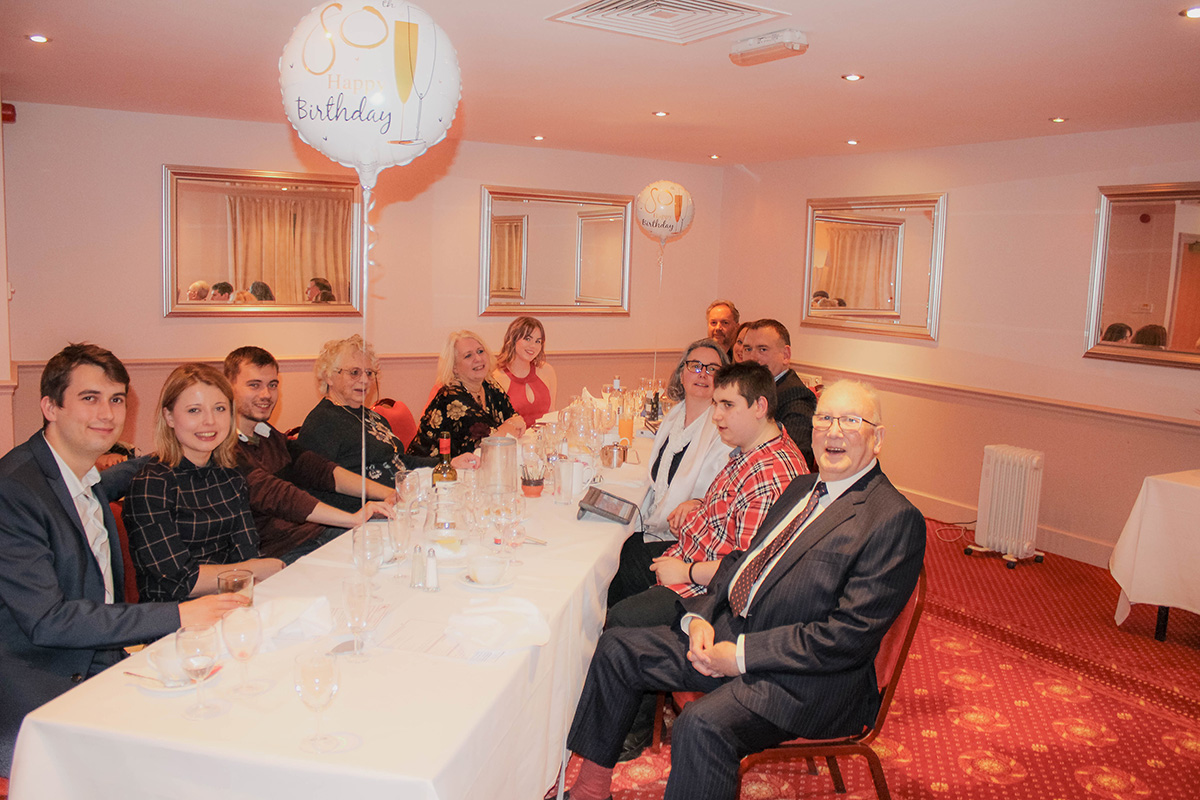
UPDATE by CM
Derek died in December 2022, but the above picture represents him at his happiest with his family. Always one to find an excuse for a party!